
Key Principle: The Phases Of A Change Initiative Lifecycle

This Playbook has a number of key principles that serve as a compass. They are intended to help everyone involved stay aligned, make good decisions, and adapt sensibly as circumstances evolve. Without a shared understanding of these foundations, it can be easy to get lost in the detail, apply processes too rigidly, or lose sight of the bigger picture.

This is a restricted area, password-protected, as is most of the Change Playbook.

This area of the Playbook describes the principle of using a common set of phases to structure all change initiatives, regardless of their size or complexity. It explains how shared phases provide a consistent framework for planning, governance, and decision-making while still allowing flexibility in how each phase is executed. By establishing a common lifecycle, the playbook area helps create a shared understanding of progress, expectations, and accountabilities across the organisation.

Some limited drill-down of the Change Playbook is provided through the <User Portal> tab on the Main Menu.
error: Content is protected !!

Ecosystem

The Office of Government Commerce And P3O®

The Office of Government Commerce (OGC) was a UK government body established in 2000 to promote efficiency and best practices in public sector procurement, project management, and programme management. One of its significant contributions was the development of the P3O® (Portfolio, Programme, and Project Offices) framework, first published in 2008. This framework provides principles and guidance on designing and operating effective support structures for delivering change. P3O® was created in response to the growing need for organisations to align their strategies with execution and to standardise the roles of PMOs across different contexts.

In 2014, the stewardship of the OGC’s best practice portfolio was transferred to AXELOS, a joint venture between the UK Cabinet Office and Capita. AXELOS continues to maintain and publish the official P3O® guidance, with the most recent version being “Portfolio, Programme and Project Offices: P3O® Guidance” (AXELOS, 2013).

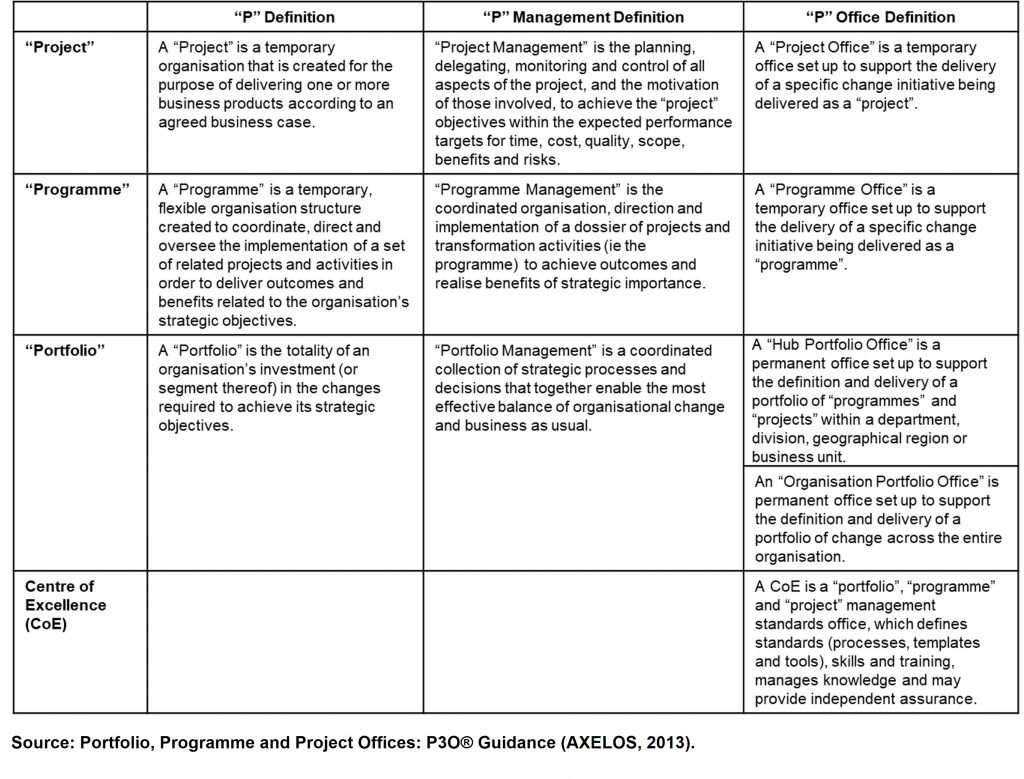
The guidance outlines a hierarchy of structures, which is summarised in Exhibit 1. It also notes that “projects” can stand alone and do not need to be part of a “programme”.

Exhibit 1: P30® Hierarchy