What Drives Organisational Change?
Organisational change is driven by the ongoing tension between managing the current state of the enterprise and adapting it for future needs. As strategies evolve in a fast-moving environment, organisations must align their ecosystems, prioritise strategic initiatives, and coordinate changes deliberately.
Contents
Formulating the Organisation’s Strategy
Organisations need a strategy to provide direction, focus, alignment, and coherence. Without a strategy, they may drift, react to events, waste resources, lose competitiveness, and struggle to execute their plans effectively.
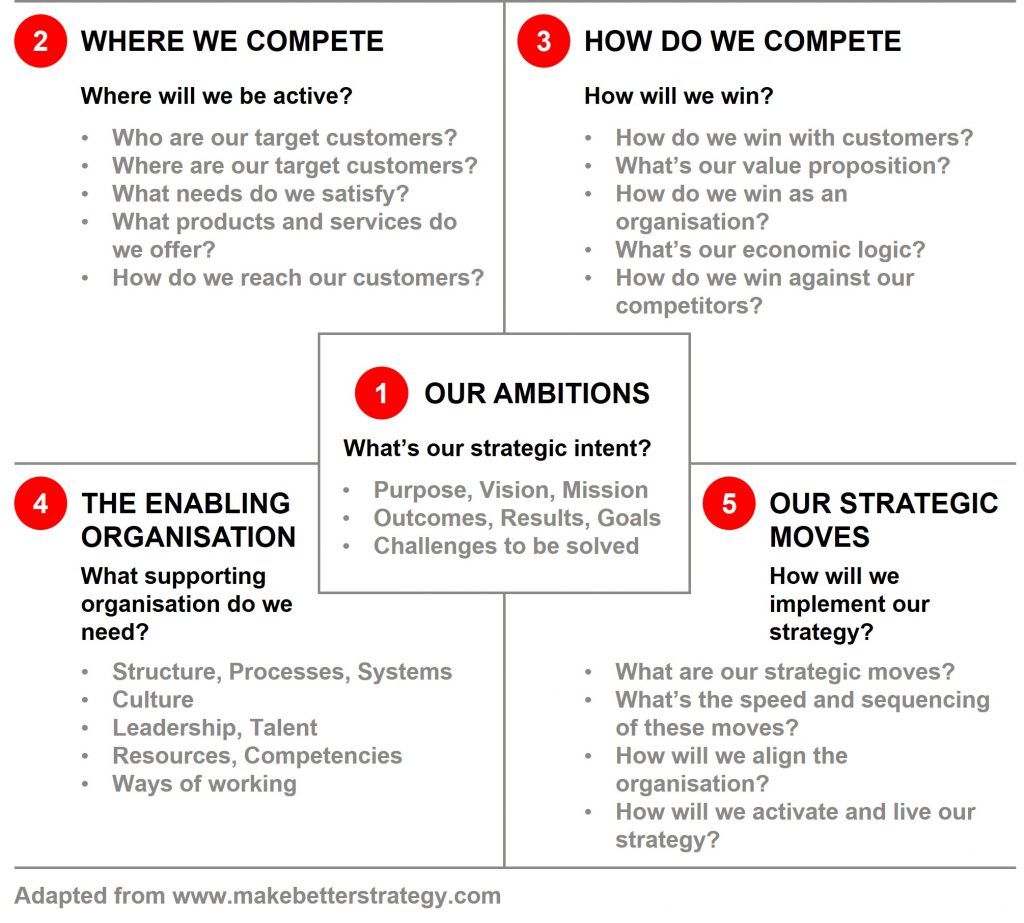
In the Private Sector, strategy centres around five key choices, as illustrated in Figure 1. Public Sector and Third Sector organisations follow the same structure, but the specific questions they address differ.
A variety of tools, including PESTLE analysis, Porter’s Five Forces, and TOWS, can be employed to evaluate an organisation’s internal and external environments, both as they currently stand and in terms of potential future developments. One of the most significant strategic decisions concerns the organisation’s value proposition. Michael Treacy and Fred Wiersema identify three value disciplines: operational excellence, product leadership, and customer intimacy. In contrast, Michael E. Porter presents three generic strategies: cost leadership, differentiation, and focus. Regardless of the value discipline or strategy used, the key principle remains the same – the organisation must commit to excelling in one chosen discipline while ensuring acceptable performance in the others.
This blog encourages the use of strategy maps to articulate and communicate strategy across the entire organisation effectively. These maps can be cascaded from the corporate level down through various functions and teams. Each level should include both prescriptive and descriptive Objectives and Key Results (OKRs). This approach creates a governance structure that enables strategic responses to emerge from the top down, bottom up, and middle out, while maintaining precise alignment with the organisation’s overall direction.
Strategy as a Continuous Process
Strategy formulation is no longer a process that occurs every few years with just an annual update. The environment in which organisations operate changes too quickly for such static cycles. Factors such as technological advances, evolving customer expectations, regulatory changes, competitive disruptions, and geopolitical uncertainties continuously reshape operating conditions.
As a result, strategy has become a dynamic and ongoing process that requires frequent monitoring, rapid interpretation of emerging signals, and timely adjustments. Instead of delivering a fixed plan, organisations must maintain an adaptable strategic direction that evolves with changing conditions. This approach ensures resilience, relevance, and the ability to seize new opportunities.
How an Organisation’s Strategy Is Executed
Strategy can only be realised through an organisation’s daily activities. Traditionally, this was known as Business as Usual (BAU). In this blog, the term Operational Continuity is used instead, highlighting that maintaining core functions while adapting to change is an active capability rather than a passive state.
Operational Continuity is based on what is referred to in this blog as the organisation’s ecosystem, which includes:
- Business Model: how value is created and captured;
- Value Chain: how work and value flow across the organisation;
- Operating Model: how capabilities, processes, governance, technology, and people are organised to deliver the strategy.
This ecosystem is the mechanism that transforms strategy into action. If any part of it is misaligned, underperforming, or no longer aligned with the strategic intent, the execution will falter.
Where Organisational Change Fits In
In today’s dynamic environment, it is likely that the current ecosystem only partially supports the enterprise’s evolving strategic goals. Organisational change aims to close the gap between the existing ecosystem and the one needed to fulfil these goals. It also addresses any underperformance within the current ecosystem.
Since strategy continually evolves, organisational change is not a one-time effort; it needs to become an ongoing capability. However, not all gaps can be closed at once. Change must be broken down into manageable components that can be scoped, sequenced, and prioritised within the organisation’s resource constraints.
Importantly, every organisational change initiative must have a clear connection to the strategy. The strategy defines the organisation’s direction and value, and change initiatives must contribute to that value. Otherwise, they risk creating confusion, duplication of efforts, and internal friction. When there is strong alignment, leaders can make informed investment decisions, avoid diluting resources, and help employees understand the purpose behind the change. This fosters commitment and coherence.
Conversely, when alignment is weak, the organisation risks pursuing disconnected or conflicting initiatives, overwhelming its employees, and becoming busier without improving.
The “Run the Enterprise / Change the Enterprise” Paradigm
The interplay between executing today’s strategy and reshaping the ecosystem for the future gives rise to the concept of “Run the Enterprise, Change the Enterprise.”
- Run The Enterprise: focuses on stability, efficiency, reliability, and delivering existing products and services well.
- Change The Enterprise: focuses on adaptation, improvement, innovation, and delivering the strategic shifts that position the organisation for the future.
The challenge, and opportunity, lies in balancing both modes simultaneously: performing well today while evolving at the pace required for tomorrow.
The Role Of An Enterprise Change Office
This blog introduces the concept of an Enterprise Change Office (ECO). While the name itself is less important, the clarity of its purpose, the influence it wields, and the outcomes it achieves are crucial.
The ECO is envisioned to have a broad and significant role. Its responsibilities begin with the fifth strategic choice outlined in Figure 1, which guides the organisation’s strategic actions. This includes sequencing initiatives, aligning the organisation, and ensuring that the strategy is both activated and integrated into daily operations. An ECO facilitates these processes by:
- Translating strategic intent into an actionable, prioritised portfolio of change initiatives;
- Ensuring initiatives are sequenced, resourced, governed, and interdependency-managed;
- Maintaining alignment as strategy evolves;
- Providing the structures, standards, and methods that ensure change is delivered coherently;
- Monitoring progress and adjusting plans as conditions shift;
- Fostering the cultural and behavioural alignment required for strategic moves to take hold.
In summary, the ECO serves as the integrator that transforms strategic choices into coordinated, enterprise-wide execution, enabling the organisation to operate effectively today while intentionally preparing for tomorrow.
Read On