The Enterprise Change Office

Why Use The Term Initiative

Needs Editing

Organisational Change Requires an Enterprise Capability

Within this website, organisational change is defined as:

“The adaptation of an organisation’s Enterprise System and, where necessary, its Governing Logic to enable the realisation of its strategy and objectives.”

The Enterprise System includes the interconnected Business Model, Value Chain, Operating Model, and Culture that enable the organisation to create value. Governing Logic refers to the underlying principles and assumptions shaping this system. Organisational change may involve adapting elements of the Enterprise System or, when necessary, reassessing and changing the Governing Logic. Further details on this definition are provided here.

Organisations rarely achieve change through a single activity. Multiple changes often occur simultaneously, competing for resources, creating dependencies, and collectively impacting the organisation’s ability to execute its strategy. Therefore, optimising organisational change requires more than managing individual initiatives; it demands an enterprise-level capability.

Why an Integrated Enterprise Capability?

Organisational change requires diverse practices and expertise, depending on the nature of the change. Change Initiatives must be properly conceived, mandated, governed, and managed. Options for adapting the Enterprise System should be developed and evaluated, human and behavioural impacts addressed, and benefits defined and tracked through to operational use. Change also relies on specialist expertise from areas such as Finance, Human Resources, Technology and Data, Risk, Legal, and Commercial, as appropriate to each initiative.

Managing changes independently does not provide sufficient enterprise capability. Individual initiatives can therefore appear well governed and well managed while, collectively, they compete for the same people, impose conflicting demands, duplicate expected benefits or exceed the organisation’s capacity to absorb change. The problem may only become visible when viewed as an enterprise system rather than a collection of individual initiatives.

Governance bodies require an enterprise-wide view of all organisational change, including strategic justification, progress, dependencies, cumulative impacts, resource needs, capacity constraints, risks, and expected benefits. The organisation must also develop and retain effective practices, knowledge, and practitioner capability, and learn systematically from experience rather than reinventing approaches for each new initiative. The enterprise capability is built by integrating the governance, design, execution, and learning of organisational change across individual initiatives and organisational boundaries, rather than duplicating existing disciplines.

An integrated enterprise function provides the organisational infrastructure to develop, connect, and continually improve these capabilities. Its purpose is not to centralise organisational change, but to enhance the enterprise’s ability to manage change effectively.

What Should This Function Be Called?

The function’s name matters less than a clear understanding of what it does and how it relates to the rest of the enterprise. This website uses the term Enterprise Change Office (ECO) for the integrated function that develops and sustains enterprise capability for organisational change. The rationale for using this terminology is explained here.

The Enterprise Change Office Construct

The ECO construct developed on this website, and presented in Figure 1, treats stewardship of enterprise organisational-change capability as its unit of concern, rather than managing the delivery system for individual initiatives.

Figure 1: The Enterprise Change Office Construct

The ECO construct also identifies specific roles through which organisational change is undertaken, including Sponsors, Initiative Managers, Change Architects, Change Engagement practitioners, Benefits practitioners and Business Change Managers. These roles recur in the following sections and are explored in more detail here.

ECO Capabilities

The ECO construct presented on this website defines four key capabilities that provide the enterprise-level infrastructure to govern, understand, support, and improve organisational change. This is not an exhaustive list of ECO activities. One or more of these capabilities support functions such as initiative mobilisation, assurance, portfolio analysis, and enterprise benefits oversight, rather than being separate capabilities.

Second-Order Transformational Change should be relatively rare, but the strategic process should explicitly test whether the existing Governing Logic can still support the organisation’s strategic intent. The need to reconsider it may also emerge between formal strategic reviews as the organisation learns from changes in its environment and from experience in pursuing strategy.

As discussed earlier, Ackerman’s Transformational Change is interpreted within this framework as Second-Order Transformational Change. Making Governing Logic an explicit subject of strategic consideration increases the organisation’s ability to recognise when such fundamental change may be required.

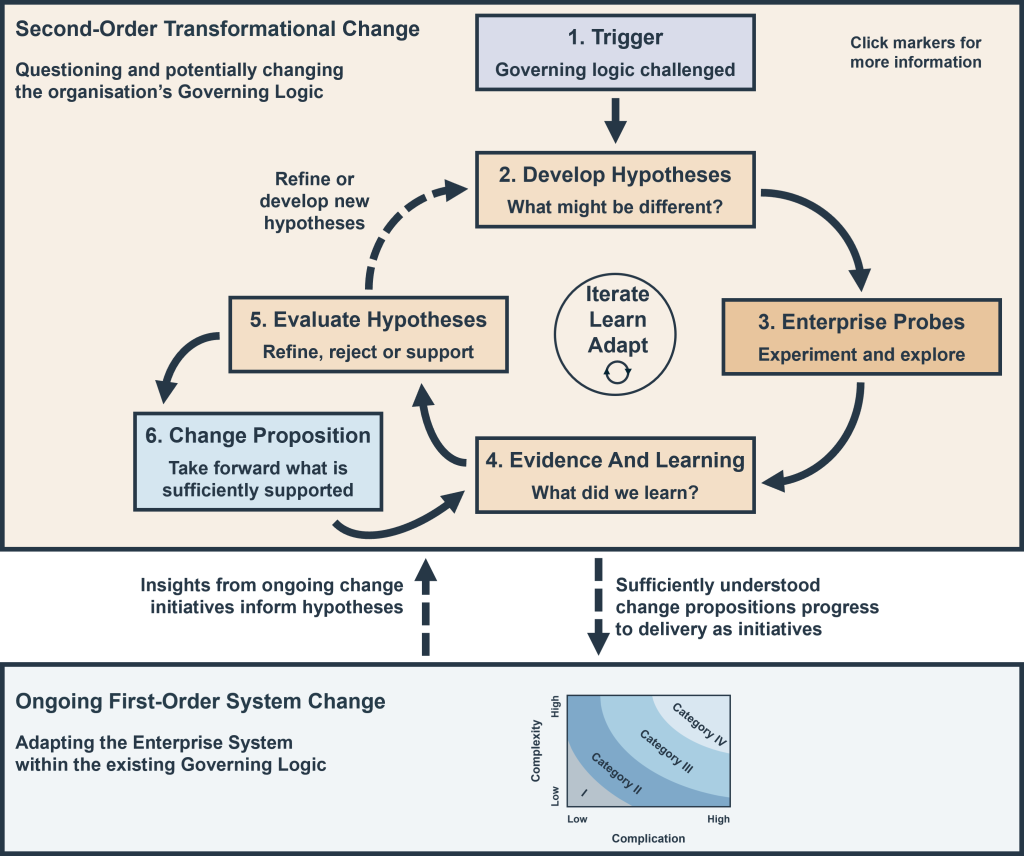
When the future Governing Logic cannot be specified with confidence, traditional programme and project methods are insufficient. Instead, Enterprise Probes—deliberate experiments and inquiries—can explore hypotheses about necessary changes to Governing Logic. Evidence and learning help refine or support these hypotheses. Well-supported hypotheses become Change Propositions, which, once understood, can move toward delivery through change initiatives. Figure 4 illustrates this process.

1. Trigger

A strategically significant signal that calls into question whether the existing Governing Logic remains fit for purpose. This corresponds to Ackerman’s idea of a wake-up call – recognition that incremental adaptation may no longer be sufficient and that fundamental organisational assumptions may need to be reconsidered.

1 of 7

2. Develop Hypotheses

Form plausible hypotheses about how the organisation’s Governing Logic might need to change. These describe possibilities to be explored and tested, rather than a predetermined future state.

2 of 7

3. Enterprise Probes

Conduct bounded, hypothesis-driven experiments to explore how the Governing Logic might need to change. Their purpose is to generate evidence and learning, not to implement a predetermined solution.

3 of 7

4. Evidence and Learning

Gather and interpret evidence from Enterprise Probes to understand how the organisation responds. Learning informs whether hypotheses should be refined, rejected or developed further.

4 of 7

5. Evaluate Hypotheses

Assess the evidence to determine whether hypotheses should be rejected, refined and tested further, or are sufficiently supported to progress towards a Change Proposition.

5 of 7

6. Change Proposition

Translate sufficiently supported learning into a defined proposition for change. Where sufficiently understood, it can progress towards delivery through change initiatives.

6 of 7
Ongoing First-Order System Change

Continues to adapt the Enterprise System within the existing Governing Logic while transformation is explored. It may range from relatively straightforward to highly complicated and complex change.

7 of 7

Figure best viewed on tablet or above

Figure 4: Second-Order Transformational Change

When the future Governing Logic cannot be specified with confidence, traditional programme and project methods are insufficient. Instead, Enterprise Probes—deliberate experiments and inquiries—can explore hypotheses about necessary changes to Governing Logic. Evidence and learning help refine or support these hypotheses. Well-supported hypotheses become Change Propositions, which, once understood, can move toward delivery through change initiatives. Figure 4 illustrates this process.

Managing both simultaneously requires Organisational Ambidexterity: the ability to continue operating and adapting within the existing organisational order while exploring the fundamentally different order that may be required for the future. 

The National Health Service in England illustrates the kind of situation in which Second-Order Transformational Change might need to be considered. Many of its challenges can undoubtedly be addressed through First-Order System Change. Persistent questions about how healthcare is organised, funded, governed and delivered may, however, require examination of assumptions underlying the existing organisational order. The diagnostic question is therefore not whether the NHS needs larger programmes successively, but whether its existing Governing Logic can still support what society requires of it.

First-Order System Change is likely to recur and, in many organisations, is effectively continuous. It adapts Culture, Business Model, Value Chain, and Operating Model within the existing Governing Logic.

As discussed earlier, Ackerman’s Developmental and Transitional Change are interpreted within this framework as forms of First-Order System Change. That distinction, however, does not adequately differentiate First-Order Change across the management challenges created by complicatedness and complexity. Here:

  • Complicatedness is the degree to which change is difficult because of the number, variety and interdependence of elements that must be understood, designed, coordinated and implemented. Complicatedness can generally be addressed through analysis, expertise, decomposition and planning, even where doing so is demanding.
  • Complexity is the degree to which change is difficult because interactions between elements, people and their environment produce responses and outcomes that cannot be confidently predicted in advance. Complexity therefore requires feedback, learning, and adaptation rather than relying solely on analysis and predetermined plans.

Practically, the distinction can be stated simply:

“Complicatedness concerns how difficult the change is to analyse and coordinate; complexity concerns how difficult its consequences are to predict.”

This distinction is important because it prevents complexity from being equated with ‘big and difficult.’ For example, a large ERP implementation may be highly complicated but not complex. Conversely, a modest change involving many autonomous actors and unpredictable responses can be highly complex without being complicated.

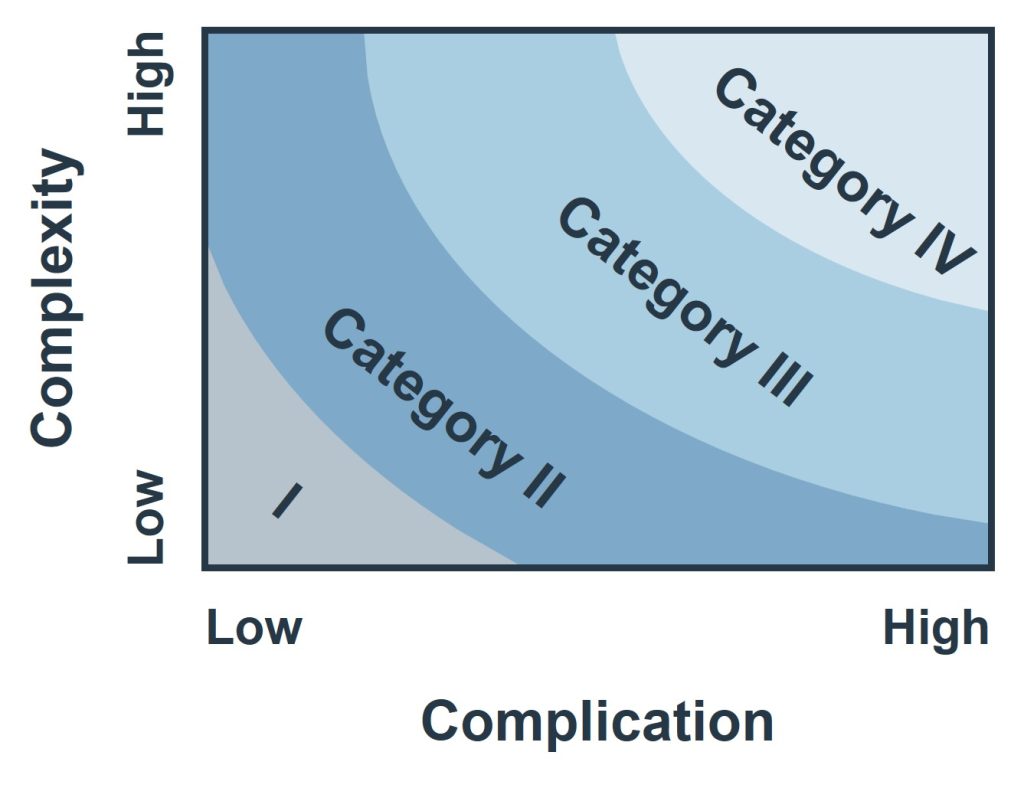
Rather than using the terms “Developmental” and “Transitional”, this website suggests that organisations categorise First-Order System Change along a continuum of four categories as shown in Figure 5.

Figure best viewed on tablet or above

Figure 5: Continuum Of Categories Of First-Order System Change

The boundaries between these categories are not universal thresholds but form a continuum based on each organisation’s assessment of the change, its environment, and capabilities. Their purpose is to guide governance and approach decisions, not to create a hierarchy of importance. The organisation should clearly communicate the rationale for categorisation.

Category I change, with low complication and complexity, focuses on improving or developing existing conditions. Category II involves more substantial movement toward a future state that remains sufficiently knowable to design and plan. Category III, with higher complexity, requires ongoing feedback, learning, and adjustment. Category IV combines high complication and complexity, requiring extensive coordination while recognising that not all interactions and outcomes can be predicted.

Importantly, Transformational Change is outside this categorisation. Increasing complicatedness or complexity does not turn First-Order System Change into Second-Order Transformational Change. The latter is a different order of change because the Governing Logic itself is reconsidered.

End Of Expandable Content

ECO Capabilities

The ECO construct presented on this website defines four ECO-stewarded practices: Initiative Management, Change Architecture, Change Engagement, and Benefits Management. A practice is considered ECO-stewarded if it focuses on organisational change, is distinct and repeatable, supports enterprise-wide development and learning, and lacks a more suitable organisational home within the enterprise.

Stewardship includes maintaining and developing the principles, methods, role expectations, guidance, practitioner capability, and organisational learning for each practice. ECO personnel do not perform all related work; Change Initiatives and other organisational change activities mainly implement these practices.

Second-Order Transformational Change should be relatively rare, but the strategic process should explicitly test whether the existing Governing Logic can still support the organisation’s strategic intent. The need to reconsider it may also emerge between formal strategic reviews as the organisation learns from changes in its environment and from experience in pursuing strategy.

As discussed earlier, Ackerman’s Transformational Change is interpreted within this framework as Second-Order Transformational Change. Making Governing Logic an explicit subject of strategic consideration increases the organisation’s ability to recognise when such fundamental change may be required.

When the future Governing Logic cannot be specified with confidence, traditional programme and project methods are insufficient. Instead, Enterprise Probes—deliberate experiments and inquiries—can explore hypotheses about necessary changes to Governing Logic. Evidence and learning help refine or support these hypotheses. Well-supported hypotheses become Change Propositions, which, once understood, can move toward delivery through change initiatives. Figure 4 illustrates this process.

1. Trigger

A strategically significant signal that calls into question whether the existing Governing Logic remains fit for purpose. This corresponds to Ackerman’s idea of a wake-up call – recognition that incremental adaptation may no longer be sufficient and that fundamental organisational assumptions may need to be reconsidered.

1 of 7

2. Develop Hypotheses

Form plausible hypotheses about how the organisation’s Governing Logic might need to change. These describe possibilities to be explored and tested, rather than a predetermined future state.

2 of 7

3. Enterprise Probes

Conduct bounded, hypothesis-driven experiments to explore how the Governing Logic might need to change. Their purpose is to generate evidence and learning, not to implement a predetermined solution.

3 of 7

4. Evidence and Learning

Gather and interpret evidence from Enterprise Probes to understand how the organisation responds. Learning informs whether hypotheses should be refined, rejected or developed further.

4 of 7

5. Evaluate Hypotheses

Assess the evidence to determine whether hypotheses should be rejected, refined and tested further, or are sufficiently supported to progress towards a Change Proposition.

5 of 7

6. Change Proposition

Translate sufficiently supported learning into a defined proposition for change. Where sufficiently understood, it can progress towards delivery through change initiatives.

6 of 7
Ongoing First-Order System Change

Continues to adapt the Enterprise System within the existing Governing Logic while transformation is explored. It may range from relatively straightforward to highly complicated and complex change.

7 of 7

Figure best viewed on tablet or above

Figure 4: Second-Order Transformational Change

When the future Governing Logic cannot be specified with confidence, traditional programme and project methods are insufficient. Instead, Enterprise Probes—deliberate experiments and inquiries—can explore hypotheses about necessary changes to Governing Logic. Evidence and learning help refine or support these hypotheses. Well-supported hypotheses become Change Propositions, which, once understood, can move toward delivery through change initiatives. Figure 4 illustrates this process.

Managing both simultaneously requires Organisational Ambidexterity: the ability to continue operating and adapting within the existing organisational order while exploring the fundamentally different order that may be required for the future. 

The National Health Service in England illustrates the kind of situation in which Second-Order Transformational Change might need to be considered. Many of its challenges can undoubtedly be addressed through First-Order System Change. Persistent questions about how healthcare is organised, funded, governed and delivered may, however, require examination of assumptions underlying the existing organisational order. The diagnostic question is therefore not whether the NHS needs larger programmes successively, but whether its existing Governing Logic can still support what society requires of it.

First-Order System Change is likely to recur and, in many organisations, is effectively continuous. It adapts Culture, Business Model, Value Chain, and Operating Model within the existing Governing Logic.

As discussed earlier, Ackerman’s Developmental and Transitional Change are interpreted within this framework as forms of First-Order System Change. That distinction, however, does not adequately differentiate First-Order Change across the management challenges created by complicatedness and complexity. Here:

  • Complicatedness is the degree to which change is difficult because of the number, variety and interdependence of elements that must be understood, designed, coordinated and implemented. Complicatedness can generally be addressed through analysis, expertise, decomposition and planning, even where doing so is demanding.
  • Complexity is the degree to which change is difficult because interactions between elements, people and their environment produce responses and outcomes that cannot be confidently predicted in advance. Complexity therefore requires feedback, learning, and adaptation rather than relying solely on analysis and predetermined plans.

Practically, the distinction can be stated simply:

“Complicatedness concerns how difficult the change is to analyse and coordinate; complexity concerns how difficult its consequences are to predict.”

This distinction is important because it prevents complexity from being equated with ‘big and difficult.’ For example, a large ERP implementation may be highly complicated but not complex. Conversely, a modest change involving many autonomous actors and unpredictable responses can be highly complex without being complicated.

Rather than using the terms “Developmental” and “Transitional”, this website suggests that organisations categorise First-Order System Change along a continuum of four categories as shown in Figure 5.

Figure best viewed on tablet or above

Figure 5: Continuum Of Categories Of First-Order System Change

The boundaries between these categories are not universal thresholds but form a continuum based on each organisation’s assessment of the change, its environment, and capabilities. Their purpose is to guide governance and approach decisions, not to create a hierarchy of importance. The organisation should clearly communicate the rationale for categorisation.

Category I change, with low complication and complexity, focuses on improving or developing existing conditions. Category II involves more substantial movement toward a future state that remains sufficiently knowable to design and plan. Category III, with higher complexity, requires ongoing feedback, learning, and adjustment. Category IV combines high complication and complexity, requiring extensive coordination while recognising that not all interactions and outcomes can be predicted.

Importantly, Transformational Change is outside this categorisation. Increasing complicatedness or complexity does not turn First-Order System Change into Second-Order Transformational Change. The latter is a different order of change because the Governing Logic itself is reconsidered.

End Of Expandable Content

Contributing Enterprise Practices

The ECO construct deliberately distinguishes ECO-Stewarded Practices from Contributing Enterprise Practices. The ECO does not, and should not, contain all the specialist expertise required for organisational change. Change Initiatives and Enterprise Probes draw on established practices across the enterprise, depending on the Business Need, affected Enterprise System elements, and the nature of the change. Examples include Finance, Human Resources, Technology and Data, Risk, Legal, and Commercial, though this list is not exhaustive.

It is important to distinguish between stewarding organisational-change practices and incorporating specialist expertise. The ECO enables relevant Contributing Enterprise Practices into organisational change, while the Initiative Manager, Change Architect, and other initiative roles integrate their contributions according to their respective responsibilities.

Contributing Enterprise Practices are considered in further detail here.

Two Orders of Organisational Change

If required capabilities can be developed by adapting the Enterprise System while the Governing Logic remains appropriate, the organisation is undergoing First-Order Change. This changes operations without altering core principles and assumptions.

If the Governing Logic is no longer appropriate or its suitability is uncertain, the organisation faces Second-Order Change. This involves reconsidering the principles shaping the Enterprise System. Second-Order Change does not assume the Governing Logic will change; instead, exploration and learning determine if and how it should change.

This distinction is not based on scale, cost, complexity, or disruption. In this framework, it depends on the organisational level of change. Large, complex changes may still be First-Order, while Second-Order Change involves questioning the Governing Logic. The two constructs are explored here.

Organisational Change Enables Strategy Realisation

Organisational change and strategy realisation are closely linked but distinct. Organisational change adapts capabilities, while strategy is realised by using those capabilities in Operational Continuity.

Designing, developing, or implementing a new capability alone does not realise strategy. A new operating model, platform, or service becomes strategically significant only when it is used operationally and contributes to the organisation’s objectives.

This distinction does not depend on the formal end of a change initiative. Changed capabilities may enter Operational Continuity gradually, with benefits emerging as they are used, not just when the initiative concludes.

The boundary between organisational change and Operational Continuity is conceptual, not strictly chronological. Organisational change adapts capability; Operational Continuity involves its ongoing use.

Organisational change adapts capability. Operational Continuity uses that capability to execute strategy and deliver value.
What Is Organisational Change Management?

If organisational change defines what is being adapted and why, organisational change management addresses how to achieve that adaptation.

Within this framework Organisational Change Management is:

“The coordinated leadership, governance, design, delivery and change engagement through which organisational change is conceived, directed, implemented, adopted and sustained.”

Organisational change management is an enterprise activity that integrates leadership, decision-making, specialist practices, and delivery capabilities to achieve change. It is not limited to a single role, function, or practitioner.

Various practice areas contribute expertise to this activity. In this framework, these include Initiative Management, Change Architecture, and Change Engagement, all integrated and supported by the Enterprise Change Office.

Bringing the Definition Together

Organisational change adapts the Enterprise System and, where necessary, its Governing Logic to provide the capabilities the organisation requires.

Those capabilities enable strategy realisation through their use in Operational Continuity, while Organisational Change Management coordinates how the change is brought about.

Explore More

Organisational Change Practice Areas

Organisational change is defined in many different ways. Explore the definition adopted by this website and the reasoning behind it.

When Did Transformation Become Just Another Meaningless Buzzword

Transformation now describes almost every kind of change. This article examines how the term lost precision and proposes a more useful way of distinguishing between system change and genuinely transformational change.
error: Content is protected !!

Does First-Order And Second-Order Change Still Apply?

First-Order and Second-Order Change were developed long before current descriptions of organisational environments such as VUCA (Volatility, Uncertainty, Complexity, Ambiguity) and BANI (Brittle, Anxious, Nonlinear, Incomprehensible). Organisations are now seen as continually adapting, rather than moving episodically between stable states. It is therefore reasonable to question whether a distinction from an earlier context remains useful.

The distinction remains relevant because First-Order Change does not necessarily mean simple, predictable, or incremental change. It can be extensive, continuous, complicated, complex, emergent, and highly uncertain. Organisations may repeatedly adapt structures, processes, technologies, and ways of working while their underlying organisational order remains intact.

VUCA and BANI may increase the frequency, interconnectedness, and unpredictability of adaptation. However, neither uncertainty nor complexity determines the order of change. An organisation can experiment, learn, and adapt continuously without fundamentally changing its organisational order.

Second-Order Change identifies a qualitatively different situation: the underlying organisational order itself becomes subject to reconsideration and potential change. Developments in markets, technology, regulation, societal expectations or other conditions may eventually challenge fundamental assumptions about how an organisation creates value, understands its identity, exercises authority, allocates resources or determines accountability. Adaptation within the existing order may then no longer be sufficient.

The boundary is not always clear. Successive First-Order adaptations may gradually challenge the existing organisational order. However, uncertainty, emergent outcomes, or experimentation alone do not make change Second-Order. The distinction lies in the level at which change occurs, not its size, frequency, or predictability.

Although the organisational environment has changed since these concepts were introduced, the distinction remains relevant. In fact, under ongoing uncertainty and adaptation, distinguishing between change within an existing order and change to that order may be even more important.

Linda Ackerman and Three Types of Change

Linda Ackerman developed an influential distinction between Developmental, Transitional and Transformational Change in Ackerman (1986). At the time, she was primarily an Organisation Development practitioner and consultant.

Ackerman defined Developmental Change as improving existing conditions. Transitional Change involves moving from a current state to a clearly defined new state, with the transition managed over a controlled period. In contrast, Transformational Change results in a fundamentally different state that emerges over time and cannot be fully specified in advance.

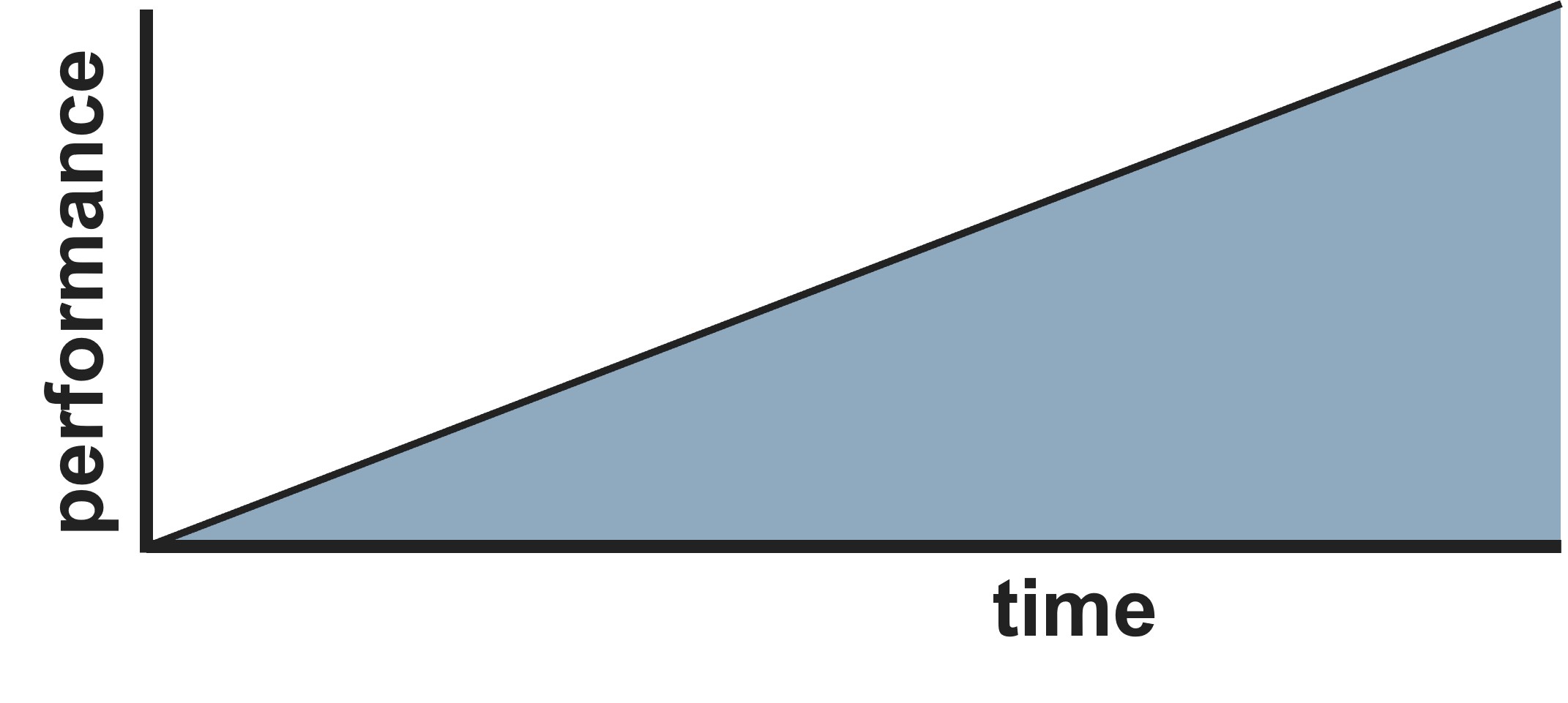
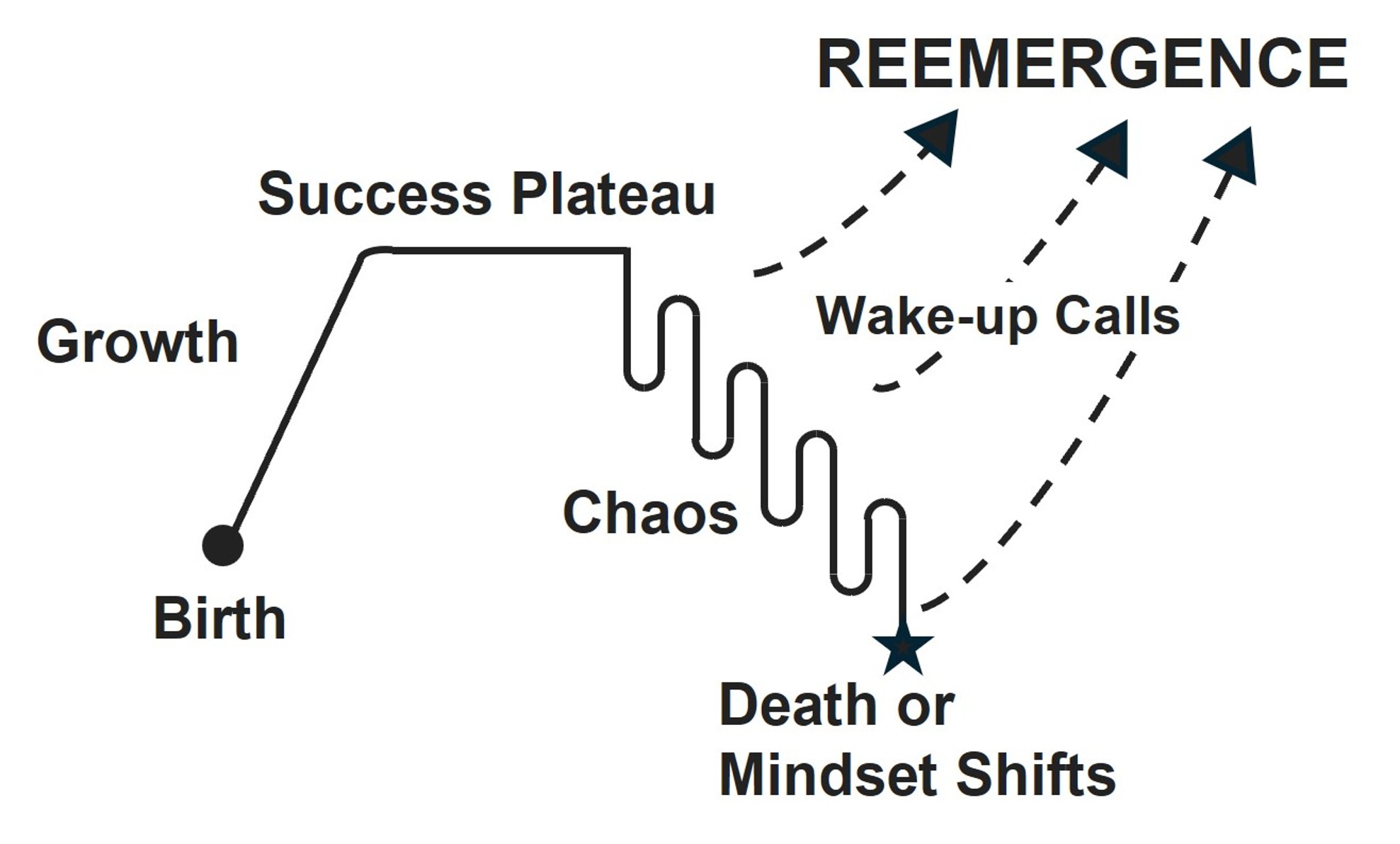
This distinction means Transformational Change is qualitatively different from improving an existing organisation or implementing a predetermined design. Figure 2 illustrates these three forms.

Developmental Change Improvement of what is; new state is a prescribed enhancement of the old state. 26_11
Transitional Change Design and implementation of a desired new state that solves an old state problem; requires management of the transition process to dismantle the old state while putting in place the new state; managed timetable. 26_12
Transformational Change

Market requirements force fundamental changes in strategy, operations, and worldview.

New state is unknown - it emerges from visioning, trial and error discovery, and learnings.

New state requires fundamental shift in mindset, organising principles, behaviour, and or culture, as well as organisational changes, all designed to support new business directions.

Critical mass of organisation must operate from new mindset and behaviour for transformation to succeed and new business model or direction to be sustained.

26_13

Figure best viewed on tablet or above

Adapted from Ackerman (1986) and Ackerman Anderson (2016) 

Figure 2: Ackerman’s Classification Of Change

On this website, daschange.info, Ackerman’s Developmental and Transitional Change are interpreted as forms of First-Order System Change, while her Transformational Change is interpreted as Second-Order Transformational Change. This is an analytical mapping made within this website and is not part of Ackerman’s original model:

  • Developmental and Transitional Change are treated as forms of First-Order Change because both can occur while the underlying organisational order remains substantially intact.
  • Transformational Change is associated with Second-Order Change, where that underlying organisational order itself becomes subject to reconsideration and potential change, and the eventual future state cannot necessarily be specified in advance.

References

Ackerman, L. S. (1986) ‘Development, Transition, or Transformation: The Question of Change in Organizations’, OD Practitioner, 18(4), pp. 1–8.

Ackerman Anderson, L. (2016) ‘Organization Development and Transformation: What It Takes’, in Rothwell, W.J., Stavros, J.M. and Sullivan, R.L. (eds.) Practicing Organization Development: Leading Transformation and Change. 4th edn. Hoboken, NJ: John Wiley & Sons, pp. 60–78

Jean Bartunek And Michael Moch And The Orders Of Change

The Organisational Development scholars Jean Bartunek and Michael Moch developed the distinction between different orders of organisational change from a cognitive perspective. In Bartunek and Moch (1987), they examined how schemata could help explain different forms of organisational change.

Schemata are organising frameworks people use to understand and interpret events. Bartunek and Moch described First-Order Change as incremental change occurring within schemata already shared by organisational members. Second-Order Change involves modification of those shared schemata themselves.

They also introduced Third-Order Change, which they described as developing the capacity of an organisation’s members to recognise their existing schemata and change them as circumstances require.

Their work suggests that fundamental organisational change may require changes to the shared frameworks through which organisational reality is understood, rather than only to structures, processes or behaviours.

References

Bartunek, J. M. & Moch, M. K. (1987) ‘First-Order, Second-Order, and Third-Order Change and Organization Development Interventions: A Cognitive Approach’, The Journal of Applied Behavioral Science, 23(4), pp. 483–500.

Amir Levy And Second-Order Change

Amir Levy was an organisational theorist whose work in the 1980s helped apply First-Order and Second-Order Change specifically to organisations.

Levy (1986) distinguished between change within an existing organisational framework and Second-Order Change, which involves more fundamental organisational transformation. Together with Uri Merry, he further developed these ideas in Levy and Merry (1986), examining organisational transformation through perspectives including organisational paradigms, culture, myths, purpose, and approaches to managing Second-Order Change.

Their work reinforced an important distinction: organisational transformation concerns a qualitative shift in the organisation and its underlying paradigm, rather than simply the quantity, scale or difficulty of change undertaken.

References

Levy, A. (1986) ‘Second-Order Planned Change: Definition and Conceptualization’, Organizational Dynamics, 15(1), pp. 5–23.

Levy, A. & Merry, U. (1986) Organizational Transformation: Approaches, Strategies, and Theories. New York: Praeger.

Paul Watzlawick And The Two Orders Of Change

Paul Watzlawick was a psychologist, communication theorist and influential figure at the Mental Research Institute in Palo Alto, California. Working with John Weakland and Richard Fisch, he drew on systems theory to examine why attempts to solve problems sometimes leave the underlying conditions that generate them unchanged.

Watzlawick et al. (1974) distinguished between First-Order and Second-Order Change. First-Order Change occurs within an existing system: its components, behaviours or processes may change while the rules governing the system remain substantially intact. Second-Order Change alters the system itself by changing the rules, assumptions or relationships through which it operates.

This distinction provides an important conceptual foundation for the Two Orders of Organisational Change used within this website.

References

Watzlawick, P., Weakland, J. H. & Fisch, R. (1974) Change: Principles of Problem Formation and Problem Resolution. New York: W. W. Norton & Company.

Ecosystem

The Office of Government Commerce And P3O®

The Office of Government Commerce (OGC) was a UK government body established in 2000 to promote efficiency and best practices in public sector procurement, project management, and programme management. One of its significant contributions was the development of the P3O® (Portfolio, Programme, and Project Offices) framework, first published in 2008. This framework provides principles and guidance on designing and operating effective support structures for delivering change. P3O® was created in response to the growing need for organisations to align their strategies with execution and to standardise the roles of PMOs across different contexts.

In 2014, the stewardship of the OGC’s best practice portfolio was transferred to AXELOS, a joint venture between the UK Cabinet Office and Capita. AXELOS continues to maintain and publish the official P3O® guidance, with the most recent version being “Portfolio, Programme and Project Offices: P3O® Guidance” (AXELOS, 2013).

The guidance outlines a hierarchy of structures, which is summarised in Exhibit 1. It also notes that “projects” can stand alone and do not need to be part of a “programme”.

Exhibit 1: P30® Hierarchy