Understanding The Organisational Change Playbook Construct
An Organisational Change Playbook establishes a shared foundation for organisational-change capability, clarifies responsibilities, ensures accessible guidance, and supports effective practice.
Contents
What Is An Organisational Playbook?
An organisational playbook consolidates the processes, responsibilities, decision-making structures, methods, and guidance used for specific activities. It offers a coherent, accessible framework for coordinated action and informed decision-making.
Playbooks are used in areas such as Sales, Cybersecurity Incident Response, and Mergers and Acquisitions Integration. While their purposes vary, each provides responsible parties with access to established knowledge and practices.
A well-designed playbook goes beyond procedures and templates by establishing essential consistency, while allowing professional judgement, adaptation, and learning from experience.
How Does This Website Apply The Playbook Concept To Organisational Change?
As explored on this page, organisational change is defined as:
“The adaptation of an organisation’s Enterprise System and, where necessary, its Governing Logic to enable the realisation of its strategy and objectives.”
Most organisational change is First-Order, involving adaptation of the Enterprise System, including the Business Model, Value Chain, and Operating Model. This website’s Organisational Change Playbook addresses First-Order change.
It offers an integrated, accessible, and maintained overview of how an organisation builds readiness and capability for change and manages changes to its Enterprise System. The Playbook addresses both ongoing development of readiness and resilience, and the management of specific changes, recognising that change capability cannot be developed through isolated initiatives alone.
The Playbook links the roles of executives, operational management, specialists, and initiative personnel, clarifying how their responsibilities and decisions interconnect. It provides the processes, methods, tools, and guidance needed for competent execution, while recognising that approaches must adapt to different circumstances. While initiative management is a key component, the Playbook also addresses broader organisational arrangements and capabilities for conceiving, implementing, and sustaining change.
Why Might an Organisation Need An Organisational Change Playbook?
Organisational change spans multiple functions, disciplines, and management levels, each with its own responsibilities, methods, and information needs. Without a unified approach, this can lead to inconsistent governance, unclear accountabilities, duplicated effort, and poor coordination. As a result, gaps may emerge between delivering initiative outputs and achieving intended outcomes, and valuable knowledge may remain siloed rather than contributing to lasting organisational capability.
An Organisational Change Playbook addresses these issues by providing a common framework that links processes, decisions, responsibilities, and supporting practices. It helps organisations move beyond building change capability for each initiative in isolation. By focusing on both enterprise-wide readiness and specific change management, the Playbook enables repeatable capability development and ensures that experience informs future improvements.
However, organisations should assess whether they need a comprehensive Playbook rather than assume they do. Needs vary based on existing arrangements, capabilities, and exposure to change; some organisations may benefit more from targeted improvements. The investment case should be based on an assessment of deficiencies, their impact, and the improvements a Playbook can reasonably deliver.
What Should an Organisational Change Playbook Contain?
Content should align with the organisation’s needs, but a comprehensive Playbook typically addresses two complementary streams:
Organisational Readiness & Resilience
This stream focuses on the organisation’s long-term capacity to manage and absorb change. It offers guidance on assessing and developing leadership, management, workforce, and organisational capabilities needed to anticipate and implement change while maintaining operational effectiveness. Governance should define how deficiencies are assessed, priorities set, and progress measured, with clear responsibilities for executive oversight, operational management, and specialist functions.
This stream covers capabilities specific to managing organisational change, drawing on functions such as HR and organisational development. It is an ongoing enterprise responsibility, not limited to launching individual initiatives. Assessing readiness for specific initiatives is covered under Change Portfolio & Initiative Management.
Change Portfolio & Initiative Management
This stream covers how organisations identify, evaluate, prioritise, govern, and coordinate changes in relation to strategy, investment, capacity, interdependencies, and expected benefits. It also includes investigating, designing, implementing, adopting, and sustaining individual changes, as well as assessing initiative-specific readiness. Processes should reflect the nature of the changes and available organisational capabilities.
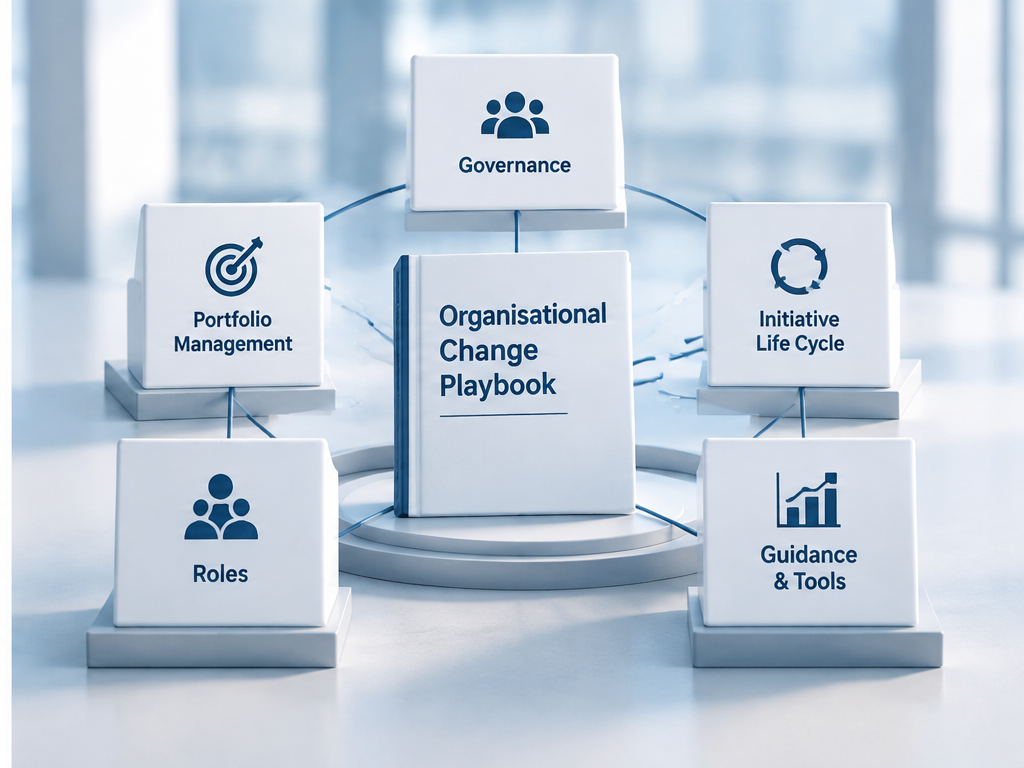
The Playbook should form an integrated framework, not just a collection of separate methodologies, procedures, or guidance documents. Its contents include:
Governance and Decision-Making
This section defines responsibilities, decision rights, delegated authorities, assurance arrangements, and evidence requirements for authorising and overseeing change. Governance should ensure accountability and appropriate challenge while enabling timely, context-appropriate decisions.
Change Processes and Activities
This section provides guidance on investigating organisational needs, developing and evaluating change proposals, designing and implementing interventions, adopting new practices, and achieving sustainable outcomes. The Playbook should clarify how activities connect, what information is needed, and how it can accommodate different approaches.
Roles and Responsibilities
This section clearly describes the roles of executives, operational managers, initiative personnel, and specialists, how responsibilities interact, and where accountability lies. It also offers guidance on required competencies and when to seek additional expertise or escalate issues.
Methods, Frameworks and Supporting Guidance
This section provides access to relevant analytical, behavioural, management, and improvement methods, as well as practical instructions, examples, templates, and evidence requirements. Guidance should specify when methods are applicable, their limitations, and the expertise required for effective use.
The goal is not to document every possible scenario or prescribe every activity in detail, but to establish a coherent foundation for competent, coordinated, and proportionate practice, supported by detailed guidance and specialist expertise as needed.
Both streams rely on coherent processes, clear responsibilities, suitable methods, and access to expert guidance.
How Should Established Frameworks and Methodologies Be Used?
A Playbook should leverage established frameworks, methodologies, and professional practices where appropriate. This approach enables organisations to benefit from existing knowledge, build on current competencies, and avoid unnecessary duplication.
A Playbook should explain the rationale for method selection, how methods connect to other activities, and the competence required for effective application. Familiarity alone does not ensure competence; participants must know their limits and when to seek specialist support. The aim is to integrate established knowledge thoughtfully, not to create another methodology or enforce competing models.
How Should A Playbook Be Structured?
This website recommends a process-driven, rather than role-driven, Organisational Change Playbook to reflect the interconnected nature of organisational-change activities and decisions.
A process-centred structure clarifies relationships across functions and professions, provides a common reference for coordination, and reduces the risk of disconnected procedures. Participants should also have access to guidance relevant to their responsibilities, with process-based and role-based navigation offering complementary perspectives rather than separate or inconsistent instructions.
The Playbook should differentiate between mandatory requirements and guidance that allows professional judgement. It must clearly define governance arrangements, decision rights, delegated authorities, and essential assurance requirements, while permitting discretion in method selection and application. The Playbook should also specify who can authorise exceptions to mandatory requirements and under what conditions.
The structure should accommodate variations in organisational change, such as scale, complexity, uncertainty, interdependencies, and impact. These factors should guide proportionate governance, documentation, assurance, and evidence requirements, rather than enforcing uniformity. Agility requires the ability to select and tailor predictive, iterative, and adaptive approaches. The goal is to ensure consistency for accountability and coordination, while maintaining flexibility to respond to new evidence.
Lean principles should guide both the Playbook’s design and use. Processes, controls, and documentation must deliver clear value, avoid duplication, and be accessible when needed. The aim is not minimal governance, but the minimum effective arrangements suited to the situation.
How Should A Playbook Be Governed And Maintained?
An effective Playbook requires clear organisational ownership and ongoing stewardship, including responsibility for coherence, content quality, and resolving inconsistencies. Development and maintenance should involve relevant functions and specialists to ensure guidance reflects both established knowledge and operational realities. Playbook ownership is separate from accountability for organisational change; executives, managers, and participants retain their respective decision rights and responsibilities.
Playbook development should start with an assessment of current organisational-change practices to identify deficiencies and determine which arrangements to retain, improve, or replace. Processes, governance, and guidance should be designed with input from those who will use them, drawing on specialist expertise. Proposed arrangements should be tested with representative users for practicality and clarity before broader rollout. Implementation should be incremental, using experience and feedback to guide further development.
Maintenance should be guided by practical evidence, not just periodic reviews. Insights from initiatives, governance, adoption outcomes, benefits realisation, and participant feedback should identify deficiencies and improvement opportunities. When practices are ineffective, the focus should be on investigation and improvement, not just enforcing compliance. Stewardship is an ongoing part of developing organisational change capability, not just an administrative task.
The Potential Weaknesses Of An Organisational Change Playbook
An Organisational Change Playbook is not automatically beneficial. If poorly designed or maintained, it can create unnecessary bureaucracy, limit professional judgement, formalise ineffective practices, or become an unused repository. These risks increase if standardisation is pursued for its own sake or if compliance is mistaken for competent practice.
Some of the potential weaknesses and possible mitigations are addressed here.
Success should be measured not by the Playbook’s completeness or compliance, but by its contribution to effective, efficient, and sustainable organisational change. Evaluation should assess whether users can find and apply guidance, whether recurring issues are addressed, and whether credible evidence shows improved practices and outcomes.
The Playbook Within The Enterprise Change Office Construct
The Enterprise Change Office (ECO) construct presented on this website offers an approach for establishing organisational arrangements to conceive, govern, implement, adopt, and sustain enterprise change. It integrates governance, responsibilities, specialist practices, and the ongoing development of organisational change capability. The Organisational Change Playbook puts these arrangements into practice by making processes, responsibilities, decision-making structures, methods, and guidance accessible to those managing change.
Within the ECO construct, the Playbook should be supported by an Enterprise Change Management Portal for information capture, workflows, reporting, and decision-making. The Playbook outlines what needs to be done and who does it, including how to use the Portal, which provides operational functionality. Together, the ECO construct, Playbook, and Portal offer an integrated approach to developing and sustaining organisational-change capability, tailored to the organisation’s needs.
Final Thoughts
An Organisational Change Playbook alone does not create change capability. It provides an integrated, maintained foundation for developing, exercising, and improving that capability. Its value depends on whether it enables the organisation to manage change more effectively, consistently, and sustainably.
A mock-up of an Organisational Change Playbook can be explored here.