The Enterprise Change Office

The Organisation’s Governing Logic and Enterprise System

How deeper organisational principles shape the system through which capability is developed, strategy pursued and value created.

Introduction

The webpage A Definition Of Organisational Change provides a definition as:

“The adaptation of an organisation’s Enterprise System and, where necessary, its Governance Logic to support the achievement of its strategy and objectives.”

The definition highlights the Enterprise System and Governing Logic as key areas for organisational change. The Enterprise System includes Culture, Business Model, Value Chain, and Operating Model. Governing Logic refers to the underlying principles and assumptions guiding enterprise-level decisions.

Organisational change may involve adapting the Enterprise System while Governing Logic remains substantially intact or, where necessary, changing the Governing Logic itself. Understanding these constructs is essential to interpreting organisational change as defined on this website.

The Governing Logic

Organisations may change structures, processes, systems, and behaviours without altering the underlying principles and assumptions that guide key decisions. These may evolve over time and may not be consistent across the organisation. Examining Governing Logic allows for a deeper understanding of what is considered appropriate, desirable, or legitimate. The nine dimensions in Figure 1, examined in greater detail here, offer complementary perspectives for this analysis.

Governing Logic Dimension Description
Value Creation The prevailing conception of what constitutes value, for whom value should be created, and how different forms of value and competing stakeholder interests should be prioritised.
Identity & Legitimacy The collective conception of what kind of organisation this is, what it is entitled or expected to do, whose expectations matter, and what forms of action and organisation are regarded as appropriate and legitimate.Row 2, Content 1
Control & Authority The principles that determine where authority should reside, how decision rights should be distributed, how much autonomy should be permitted, and how organisational activity should be controlled.
Strategy The prevailing view of how strategic direction should be determined, who should shape it, how deliberately it can be formulated, and how the organisation should respond to learning and changing circumstances.
Incentive & Reinforcement The established beliefs about what behaviours, decisions and outcomes should be encouraged, rewarded or discouraged, and the mechanisms through which these expectations are reinforced.
Resource Allocation & Investment The principles through which financial, human and other scarce resources are allocated, investment priorities determined, and competing demands resolved.
Risk & Accountability The accepted view of what risks are appropriate, who may take them, where responsibility for decisions and outcomes resides, and how accountability should be exercised.
Information & Transparency The conventions governing who should have access to information, how openly it should flow across organisational boundaries, what should be disclosed, and how information should inform decision-making.
Time Horizon & Cadence The prevailing orientation towards the time horizons over which performance and value are considered, how quickly decisions and results are expected, and the rhythms through which the organisation plans, reviews and adapts.

Figure 1: The Dimensions Of Governing Logic

The nine dimensions are not hierarchical or independent checklist items. Instead, they form a system of mutually reinforcing principles and assumptions, each influencing and being influenced by the others. Their significance varies by organisational context.

Some dimensions, such as Identity & Legitimacy and Value Creation, may be more foundational, shaping the organisation’s self-understanding, stakeholders, and values. However, there is no fixed hierarchy, as other dimensions can reinforce or challenge these core beliefs.

Ideally, Governing Logic would be consciously aligned with the organisation’s purpose and strategy. In practice, it often develops over time through decisions, practices, leadership behaviours, and responses to change, with some assumptions becoming deeply embedded and rarely questioned.

The Enterprise System

The Enterprise System does not replace established concepts such as organisational design, architecture, or operating models. Instead, it serves as an analytical lens that integrates four distinct perspectives to examine organisational capability and change. Considering these together helps identify how changes in one area may affect others, while maintaining clear analytical distinctions.

The perspectives are:

Culture includes the shared assumptions, norms, and behaviours shaped by and interacting with Governing Logic. It influences how people interpret situations and act within the organisation, affecting how formal arrangements function and whether they reinforce or undermine changes in the Enterprise System.

The Culture Canvas, as presented in Figure 2, summarises the main facets through which an organisation’s culture can be systematically examined and assessed.

Figure 2: Culture Canvas

Culture influences the Business Model, Value Chain, and Operating Model by shaping how each operates in practice. It affects perceptions of value and stakeholders, interactions across the Value Chain, and the functioning of structures and processes in the Operating Model. These elements can also reinforce or alter the organisation’s culture.

Culture and Governing Logic overlap, as both involve deeply embedded organisational assumptions. The distinction here is primarily analytical focus:

  • Governing Logic concerns the principles and assumptions that shape enterprise-level choices about matters such as value creation, authority, strategy, resource allocation, risk and legitimacy.
  • Culture concerns the socially established assumptions, norms and patterns of behaviour through which people interpret situations and act in organisational life.

The two are closely connected. Governing Logic shapes Culture, while established cultural patterns can reinforce or challenge Governing Logic. Organisational culture is discussed in more detail here

The Business Model explains how the organisation creates, delivers, and captures value, tailored to its nature and purpose. The Business Model Canvas, as presented in Figure 3 and explained here, summarises the key elements needed to understand this process.

Figure 3: Business Model Canvas

The presented canvas is designed for private sector organisations and should be adapted for public and third sector contexts.

Michael Porter developed the Value Chain, which maps the connected activities that create and deliver value as described in the Business Model. It provides a cross-functional view, showing how activities combine to produce outcomes rather than focusing on individual processes or departments.

Figure 4 presents an adapted Value Chain, described in more detail here. The primary activities shown are generic and should be tailored to the specific organisation being assessed.

Figure 4: Value Chain

The Operating Model describes how the organisation organises and enables the activities identified in the Value Chain. The Operating Model Canvas in Figure 5 provides a structured view of the main organisational arrangements supporting these activities.

Figure 5: Operating Model Canvas

Some frameworks use Operating Model to include aspects of the Business Model and Value Chain. This website treats them separately, as each addresses different analytical questions: how value is created, through which activities, and how those activities are organised and enabled.

The Relationship Between The Governing Logic And The Enterprise System

Governing Logic is reflected in the Enterprise System. Assumptions about value creation shape the Business Model and Value Chain; assumptions about authority and accountability influence the Operating Model; and assumptions about behaviour, identity, and legitimacy are expressed and reinforced through Culture.

The relationship is reciprocal. The Enterprise System does not merely implement Governing Logic; experiences, behaviours, and outcomes within the system can reinforce or challenge existing assumptions. New practices may prompt reconsideration of previously unquestioned beliefs. Governing Logic and the Enterprise System are mutually influential but remain analytically distinct.

Summary

Governing Logic and the Enterprise System offer complementary perspectives on organisational capability. Governing Logic describes the deeper principles shaping enterprise-level choices, while the Enterprise System integrates Culture, Business Model, Value Chain, and Operating Model to examine capability. Together, they explain how an organisation pursues strategy and creates value through operational continuity.

The relationship between Governing Logic and the Enterprise System is reciprocal, not hierarchical. Governing Logic shapes the Enterprise System, while experiences and outcomes within the system can reinforce or alter Governing Logic. Neither is an organisational capability on its own; their interaction shapes the organisation’s capabilities. Figure 6 summarises these relationships.

Explore More

Understanding The Governing Logic

This website adopts a strategy-led framework that examines the relationships between strategy, the Enterprise System, Operational Continuity, Governance Logic, and the Two Orders of Organisational Change.

Mapping The Enterprise System

This website adopts a strategy-led framework that examines the relationships between strategy, the Enterprise System, Operational Continuity, Governance Logic, and the Two Orders of Organisational Change.
error: Content is protected !!

Does First- and Second-Order Change Still Apply?

A valid question is whether these concepts, developed in a different era, remain relevant today. Organisations now operate in environments described as VUCA – Volatile, Complex, Nonlinear, and Continuously Changing. Recently, BANI – Brittle, Anxious, Nonlinear, and Incomprehensible – has joined VUCA in describing such conditions. Does thinking from the 1970s and 1980s still provide value?

These concepts remain useful because First-Order and Second-Order Change classify what is being changed, not the environment in which change occurs.

An organisation in a highly uncertain environment may continually adapt its processes, structures, technologies, and capabilities, while its underlying assumptions and principles remain intact. Regardless of the extent or complexity, such adaptations are considered First-Order Change as defined here.

At times, environmental changes may challenge these underlying assumptions. When an organisation must reconsider how it creates value, exercises authority, allocates resources, defines its identity, or manages accountability, it enters the realm of Second-Order Change.

This distinction does not require change to move neatly from one stable state to another. Continuous adaptation, experimentation, and emergence can all occur within First-Order Change. The distinction is analytical, focusing on what is changing rather than the timing or frequency of change.

The boundary between these types of change may not always be clear, especially when ongoing adaptation starts to challenge the organisation’s underlying assumptions. However, the distinction remains analytically valuable: it clarifies whether change occurs within the existing Governing Logic or if that logic itself is being reconsidered.

VUCA and BANI offer different ways to describe organisational environments, but they do not replace the need to ask a fundamental question: Are we changing the organisational system within its existing logic, or does that logic itself require reconsideration?

Linda Ackerman and Three Types of Change

Linda Ackerman developed an influential distinction between Developmental, Transitional and Transformational Change in Ackerman (1986). At the time, she was primarily an Organisation Development practitioner and consultant.

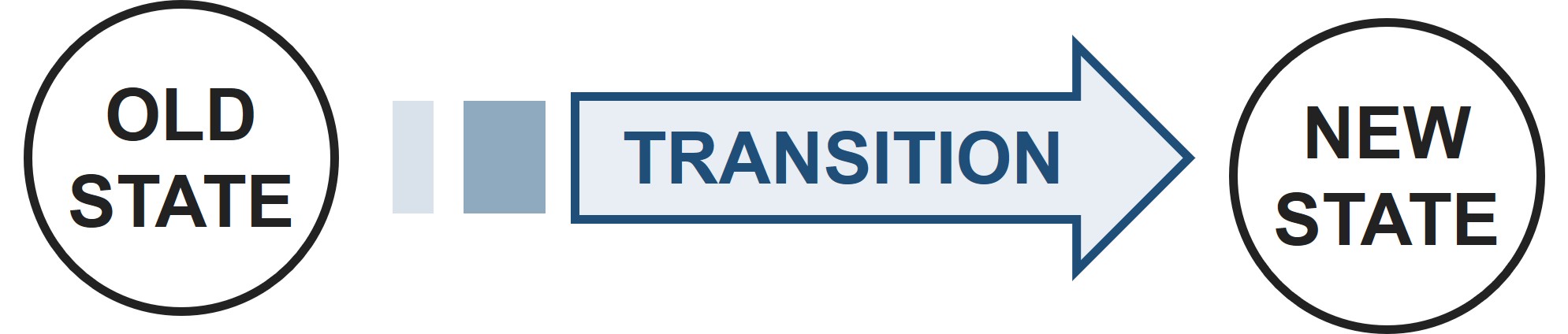
Ackerman defined Developmental Change as improving existing conditions. Transitional Change involves moving from a current state to a clearly defined new state, with the transition managed over a controlled period. In contrast, Transformational Change results in a new state that emerges over time and is not fully known in advance.

This distinction is important because it makes transformation qualitatively different from continuous improvement or implementing a set organisational design. The three types of change are explored in Figure 2.

Developmental Change Improvement of what is; new state is a prescribed enhancement of the old state. 26_11
Transitional Change Design and implementation of a desired new state that solves an old state problem; requires management of the transition process to dismantle the old state while putting in place the new state; managed timetable. 26_12
Transformational Change

Market requirements force fundamental changes in strategy, operations, and worldview.

New state is unknown - it emerges from visioning, trial and error discovery, and learnings.

New state requires fundamental shift in mindset, organising principles, behaviour, and or culture, as well as organisational changes, all designed to support new business directions.

Critical mass of organisation must operate from new mindset and behaviour for transformation to succeed and new business model or direction to be sustained.

26_13

Figure best viewed on tablet or above

Figure 2: Ackerman’s Classification Of Change

On this website, daschange.info, Ackerman’s Developmental and Transitional Change are considered forms of First-Order System Change, while Transformational Change aligns with Second-Order Transformational Change. This mapping is an analytical interpretation provided by this website, and not part of Ackerman’s original model:

  • Developmental and Transitional Change are treated as forms of First-Order Change, since both can occur while the underlying organisational order remains substantially intact.
  • Transformational Change is associated with Second-Order Change, where that underlying order itself is changing, and the eventual future state cannot necessarily be specified in advance.

Jean Bartunek and Michael Moch and the Orders of Change

The Organisational Development scholars Jean Bartunek and Michael Moch developed the distinction between different orders of organisational change from a cognitive perspective. In Bartunek and Moch (1987), they examined how the concept of schemata could help explain different forms of organisational change.

Schemata are organising frameworks through which people understand and interpret events. Bartunek and Moch described First-Order Change as incremental change occurring within schemata already shared by organisational members. Second-Order Change involves modification of those shared schemata themselves.

They also introduced Third-Order Change, which they described as developing the capacity of an organisation’s members to recognise their existing schemata and change them as circumstances require.

Their work extended the distinction between First-Order and Second-Order Change by highlighting the importance of how organisational members interpret their environment. It demonstrated that fundamental change may require altering the shared frameworks through which organisational reality is understood, not just structures, processes, or behaviours.

Amir Levy and Second-Order Change

Amir Levy was an organisational theorist whose work in the 1980s helped develop the distinction between First-Order and Second-Order Change specifically in relation to organisations.

Levy (1986) distinguished between changes within an existing organisational framework and Second-Order Change, which involves more fundamental organisational transformation. He characterised Second-Order Change as multidimensional, multilevel, qualitative, and discontinuous, involving a shift in organisational paradigm.

Together with Uri Merry, Levy developed these ideas further in Levy and Merry (1986). Their work examined organisational transformation through a range of perspectives, including organisational paradigms, culture, myths, purpose and approaches to managing Second-Order Change.

Levy’s work was instrumental in defining organisational transformation as conceptually distinct from extensive or incremental change. Transformation involves a qualitative shift in the organisation and its underlying paradigm, not just the scale or quantity of changes.

Paul Watzlawick and the Two Orders of Change

Paul Watzlawick was a psychologist, communication theorist and influential figure at the Mental Research Institute in Palo Alto, California. Working with John Weakland and Richard Fisch, he drew on systems theory to examine why attempts to solve problems sometimes leave the underlying conditions that generate them unchanged.

Watzlawick et al (1974) distinguished between First-Order and Second-Order Change. First-Order Change occurs within an existing system: its components, behaviours or processes may change while the rules governing the system remain substantially intact. Second-Order Change alters the system itself by changing the rules, assumptions or relationships through which it operates.

This distinction was further developed and applied to organisational change by Levy, Bartunek, and Moch. Ackerman, meanwhile, introduced a related framework distinguishing Developmental, Transitional, and Transformational Change.

Watzlawick et al. provides an important conceptual foundation for the Two Orders of Organisational Change used within this website.

Ecosystem

The Office of Government Commerce And P3O®

The Office of Government Commerce (OGC) was a UK government body established in 2000 to promote efficiency and best practices in public sector procurement, project management, and programme management. One of its significant contributions was the development of the P3O® (Portfolio, Programme, and Project Offices) framework, first published in 2008. This framework provides principles and guidance on designing and operating effective support structures for delivering change. P3O® was created in response to the growing need for organisations to align their strategies with execution and to standardise the roles of PMOs across different contexts.

In 2014, the stewardship of the OGC’s best practice portfolio was transferred to AXELOS, a joint venture between the UK Cabinet Office and Capita. AXELOS continues to maintain and publish the official P3O® guidance, with the most recent version being “Portfolio, Programme and Project Offices: P3O® Guidance” (AXELOS, 2013).

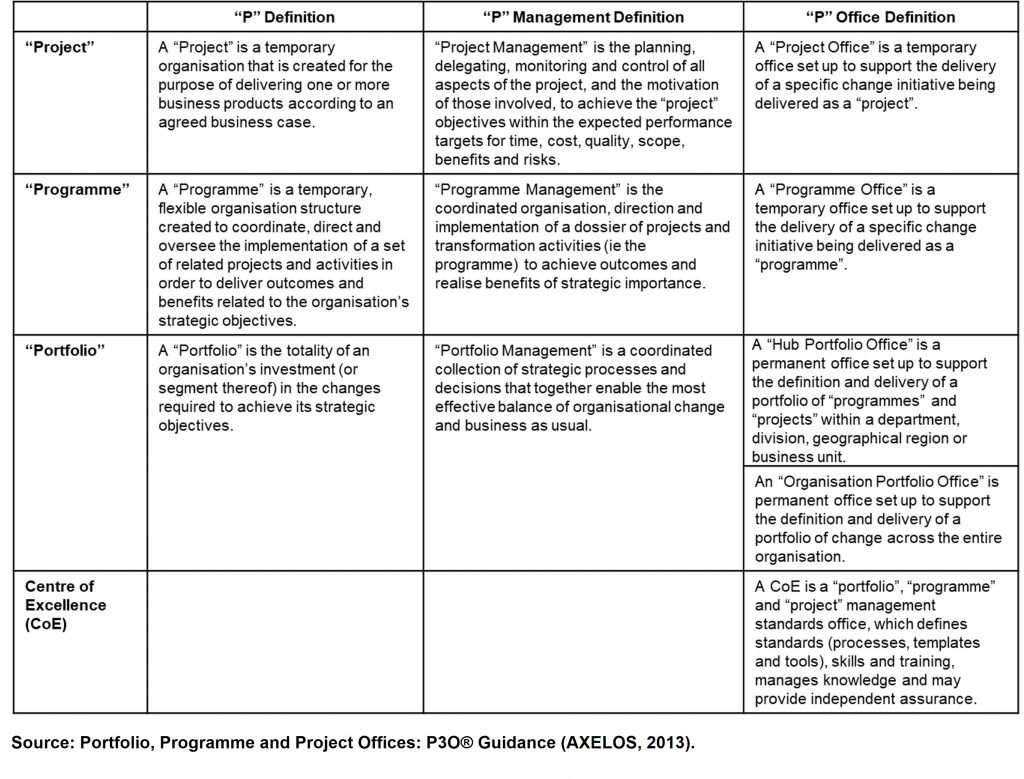
The guidance outlines a hierarchy of structures, which is summarised in Exhibit 1. It also notes that “projects” can stand alone and do not need to be part of a “programme”.

Exhibit 1: P30® Hierarchy