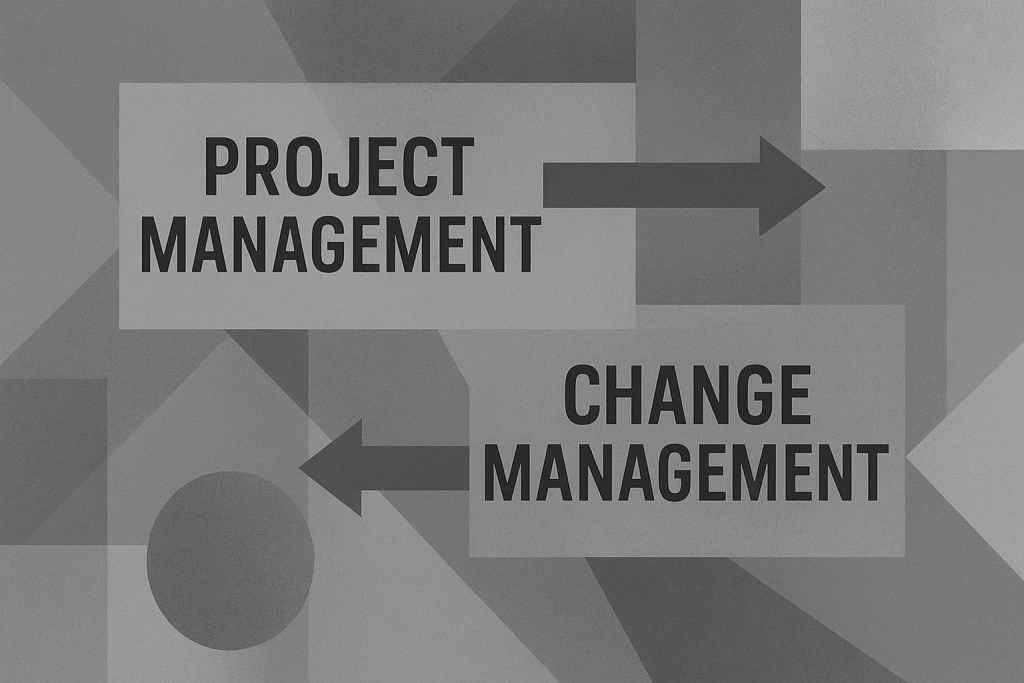
The False Binary Dichotomy Of “Project Management” versus “Change Management”
Organisational discussions about implementing change often frame the issue as a conflict between “project management” and “change management.”
In the worst cases, this leads to the assumption that these are two competing disciplines – one focused on delivering solutions, while the other aims to facilitate people’s adoption of those solutions. However, this perspective is misleading. It creates a false dichotomy that does not accurately reflect how change occurs in practice.
Contents
Origins Of Dichotomy
The concept of a false binary dichotomy may have originated in the 1990s, when a proprietary methodology was developed for what was referred to as the “people side of change.”
This methodology defines “change management” as the application of a structured process and a set of tools to manage the human aspect of change and achieve a desired outcome. To align with its own goals, the methodology categorises anything outside of this definition as “project management”.
Weaknesses With The False Binary Dichotomy
There are several weaknesses in the false binary dichotomy of “project management” versus “change management.” These include:
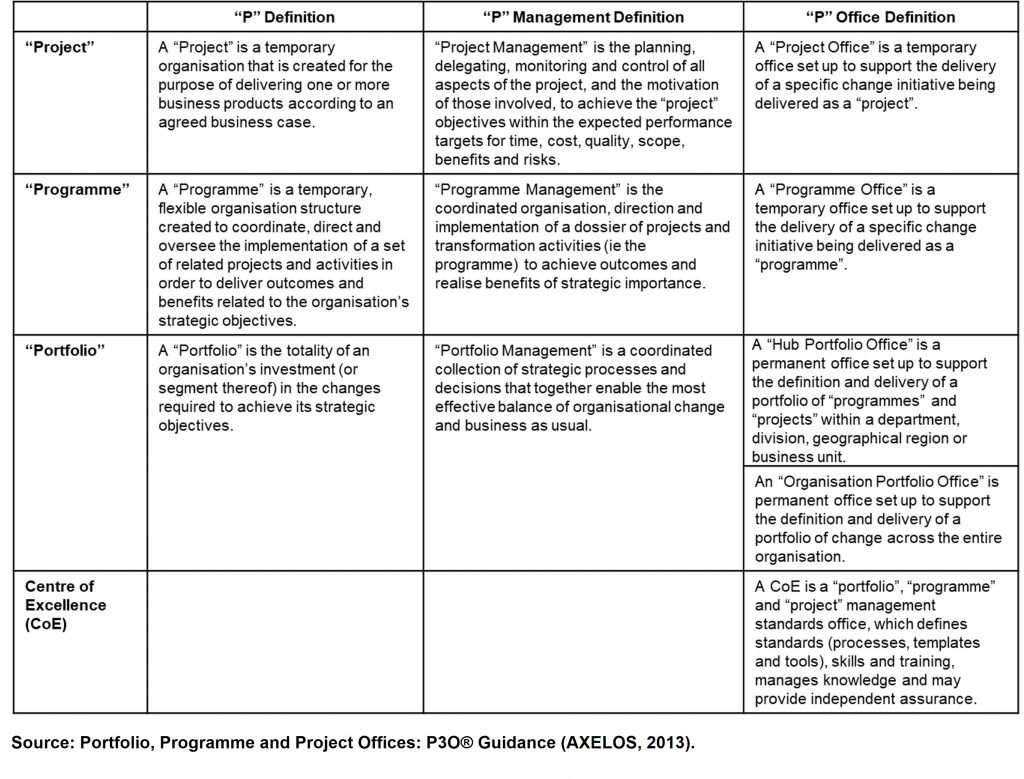
First Weakness: What Even Is A "Project"?
One source of confusion is the term “project” itself. In reality, organisations rarely agree on what defines a project.
Ironically, the methodology mentioned earlier also employs different terms. It refers to change as the project, initiative, or solution introduced within the organisation to improve workflows, solve problems, or seize opportunities. This blog, daschange.info, consistently uses the term “initiative”.
Second Weakness: Behavioural Change Cannot Be Managed
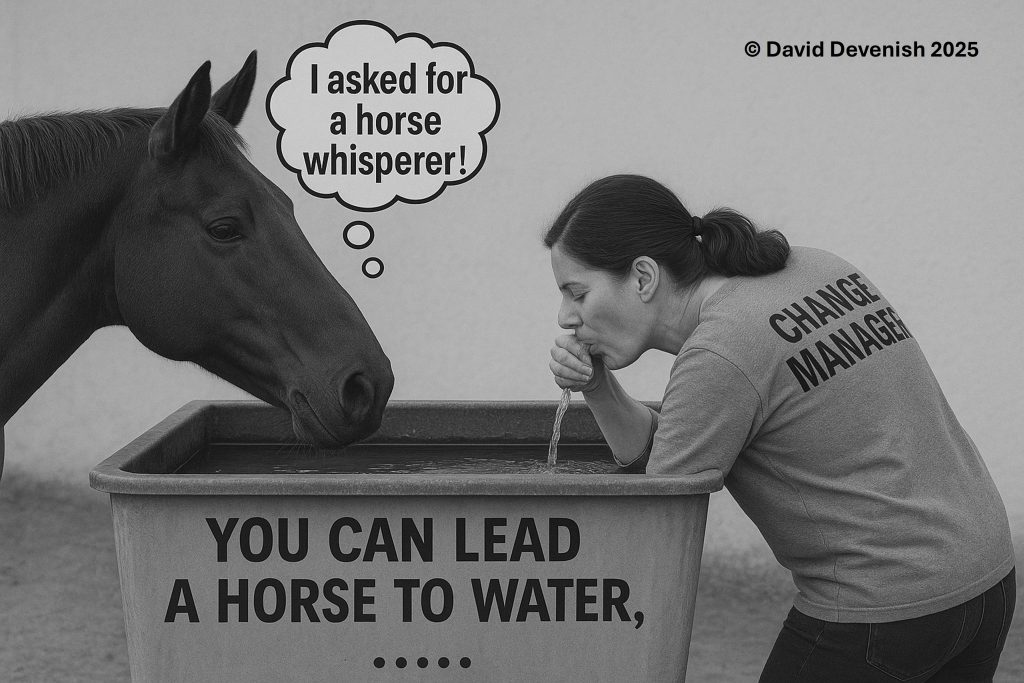
Behavioural change is challenging to manage because human, (or animal), behaviour is inherently complex, dynamic, and context-dependent. The term “management” suggests control, predictability, and linear cause-and-effect relationships—attributes that do not apply to how individuals think, feel, and act within organisations. In essence, you cannot manage behaviour as you would manage a process or a budget; people, (or animals), are not mechanical components in a system.
Instead of attempting to manage behaviour, organisations should focus on enabling and influencing it. This involves creating the right environment and conditions for behavioural change to occur naturally and sustainably. As a result, the role of Change Engagement Practitioners shifts from controlling behaviour to facilitating learning, experimentation, and reflection. This approach allows individuals to internalise change rather than merely comply with it.
Third Weakness: Project Managers Don't Deliver Solutions
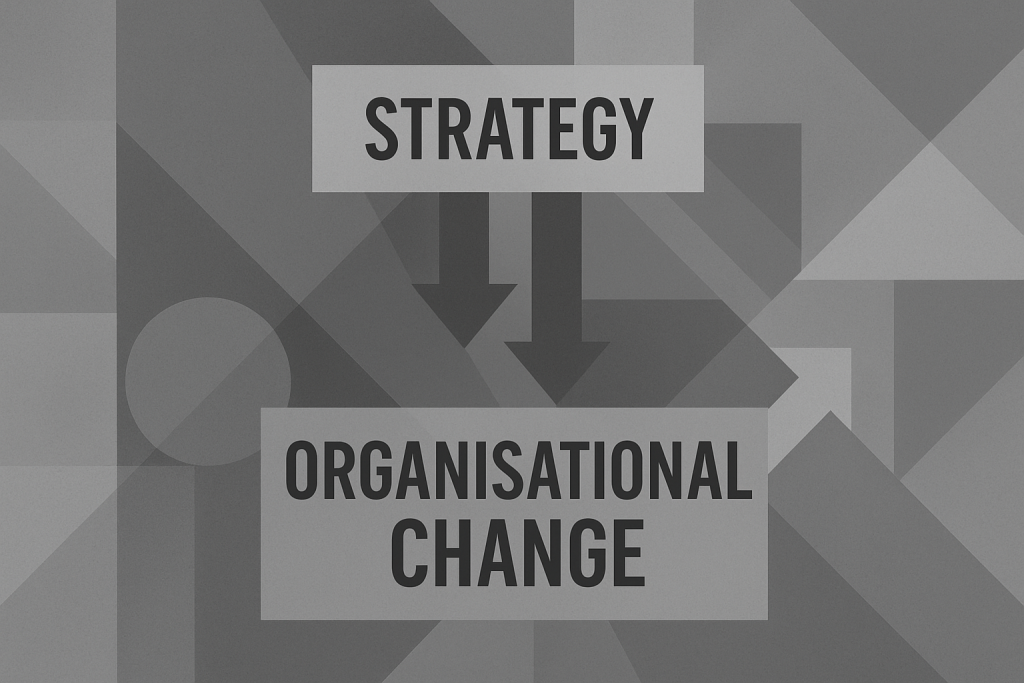
Another common misconception that has carried through from the methodology referenced above is that “project management” is about “delivering a solution.”
In reality, understanding the problem, considering options, designing, developing, and integrating a solution to deliver organisational outcomes is the work of many Domain Experts. These Domain Experts include business analysts, change engagement practitioners, engineers, designers, IT specialists, HR specialists and many others.
In fact, in many organisations, the “traditional” role of the “Project Manager” is diminishing as self-managing teams increasingly adopt Agile frameworks.
What "Project Management" Really Is?"
The methodology referenced above defines “project management” as “the use of specific knowledge, skills, tools, and techniques to deliver something of value to people”. But is this correct?
A Better Frame: Integrated Initiative Management
Instead of clinging to the false binary dichotomy of “project management” versus “change management”, it is more useful to think in terms of Initiative Management.
Here, Initiative Management is defined as:
“The action of carrying out the coordinated organisation, direction and implementation of a dossier of workstreams and change engagement activities to achieve outcomes and realise benefits of strategic importance to the enterprise.”
Initiative Management draws on the principles of the Axelos publication “Managing Successful Programmes”.
The role of Initiative Management is not to do the work of the Domain Experts, but to coordinate it within an overall cost/time envelope to realise the benefits. Initiative Management is a leadership and coordination function, not a technical one.
An Initiative Manager’s effectiveness depends less on their ability to “do the work” and more on their ability to create the conditions in which others can do the work well — through clarity, communication, and motivation. This means aligning timelines and resolving dependencies across all workstreams, understanding risks, and ensuring the efforts of different Domain Expert teams contribute to a coherent whole.
The Role Of An Enterprise Change Office
This blog, daschange.info, introduces the construct of an Enterprise Change Office (ECO).
The ECO serves as an enabler for the integrated realisation of benefits. It creates an environment where Initiative Managers, Change Engagement Practitioners, and Domain Experts can work together cohesively, balancing structure with adaptability and planning with learning.
By establishing common frameworks, a shared language, and integrated governance, the ECO helps teams move beyond the narrow definitions of “project” and “change.” Instead, the focus shifts toward outcomes, interdependencies, and value realisation. This includes supporting leaders in understanding that behavioural change cannot be managed solely through control mechanisms; rather, it must be nurtured through engagement, trust, and systemic alignment.