Why Use the Label Enterprise Change Office?
The label matters less than the construct behind it. The Enterprise Change Office is used for a function whose primary concern is stewarding the enterprise capability for organisational change, while recognising that other names and organisational arrangements are possible.
Contents
Introduction
Labels for organisational change functions keep evolving. The Project Management Institute’s (PMI) publication “Project Management Offices: A Practice Guide” notes that PMOs are complex and lack universal consensus.
The guide identifies several PMO forms, including Strategic PMO, Enterprise PMO, Portfolio Management Office, Programme Management Office, Transformation Management Office, and Value Management Office.
This website maintains that no single label is inherently correct. What matters is the underlying construct: the function’s purpose, scope, capabilities, accountabilities, decision rights, and its boundaries with other enterprise functions.
The label Enterprise Change Office (ECO) is used here to describe an integrated function focused on developing and stewarding the organisation’s capability for organisational change.
The Starting Point Is Organisational Change
This website defines organisational change as:
The adaptation of an organisation’s Enterprise System and, where necessary, its Governing Logic to enable the realisation of its strategy and objectives.
This definition forms the basis for the ECO construct. Organisational change involves adapting the Enterprise System and, when necessary, its Governing Logic. The capability required extends beyond managing initiatives through project and programme disciplines. It also includes identifying capability gaps created by strategy, determining which aspects of the Enterprise System require change, engaging stakeholders, establishing conditions for adoption and benefits realisation, and addressing Second-Order Change when the future organisation is not yet clearly defined.
The ECO construct addresses a broader question than the effective delivery of individual projects and programmes. It focuses on how the enterprise develops and sustains the capability for organisational change required by its strategy and objectives. The term ECO describes the organisational locus for stewarding this capability, rather than defining the function by a specific change mechanism.
Considering Alternative Functional Forms
The literature offers various terms for functions involved in organisational change. These functions often share capabilities, and distinctions between them are not always clear. The following comparison focuses on each function’s primary unit of concern and its organising framework.
Transformation Management Office
The PMI practice guide describes a Transformation Management Office (TMO) as driving and managing large-scale organisational change initiatives. The TMO oversees and coordinates programmes and projects critical to achieving strategic goals, helping maintain alignment with the organisation’s vision and strategy.
A common conception of the TMO constructs the office around a portfolio of change initiatives. In such conceptions, its remit may extend considerably beyond project delivery, but the portfolio remains the principal organising frame.
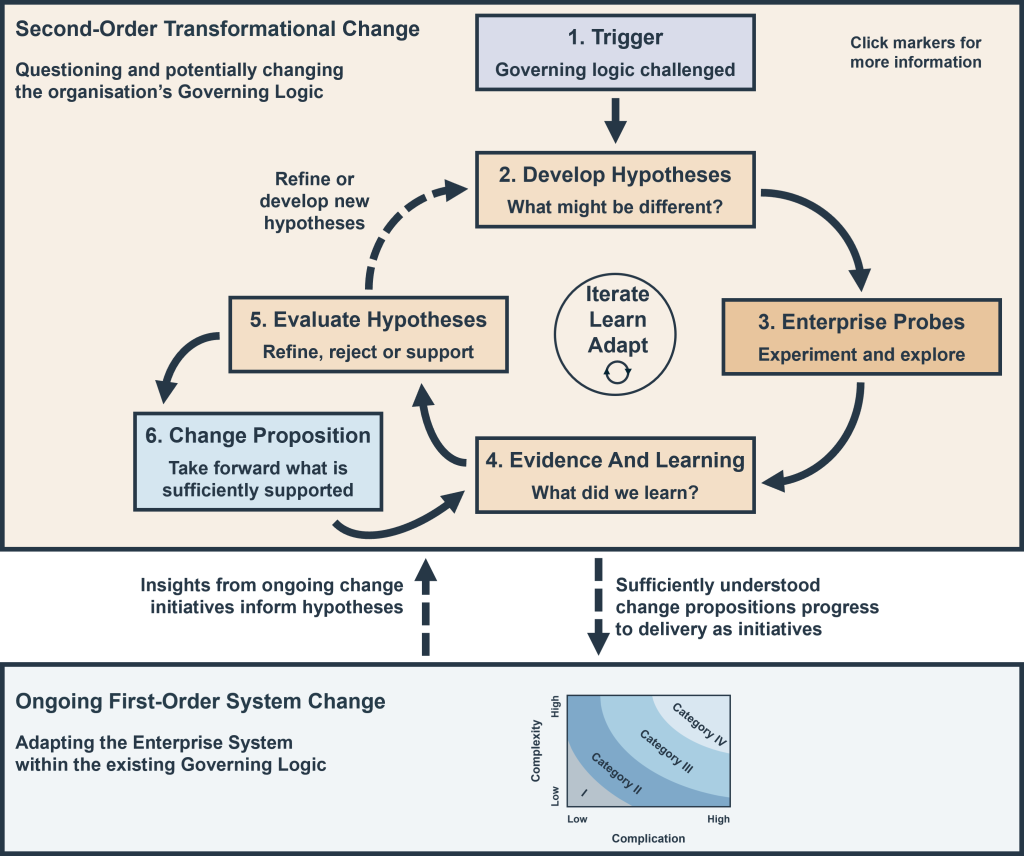
This website adopts a different conception of transformation. It distinguishes between First-Order System Change, which adapts the Enterprise System within the existing Governing Logic, and Second-Order Transformational Change, which changes that Governing Logic or arises where its continuing suitability is uncertain. Within the construct developed on this website, as expanded on here, transformation is therefore treated as a particular order of organisational change, rather than principally as a description of its size, scale or complexity.
The ECO adopts a different organising framework. Its primary concern is the enterprise capability for organisational change, covering both First-Order System Change and the exploration needed for Second-Order Change. This capability is distributed across the enterprise, with the ECO serving as the organisational locus for stewardship, integration, governance, development, and continuous improvement.
1. Trigger
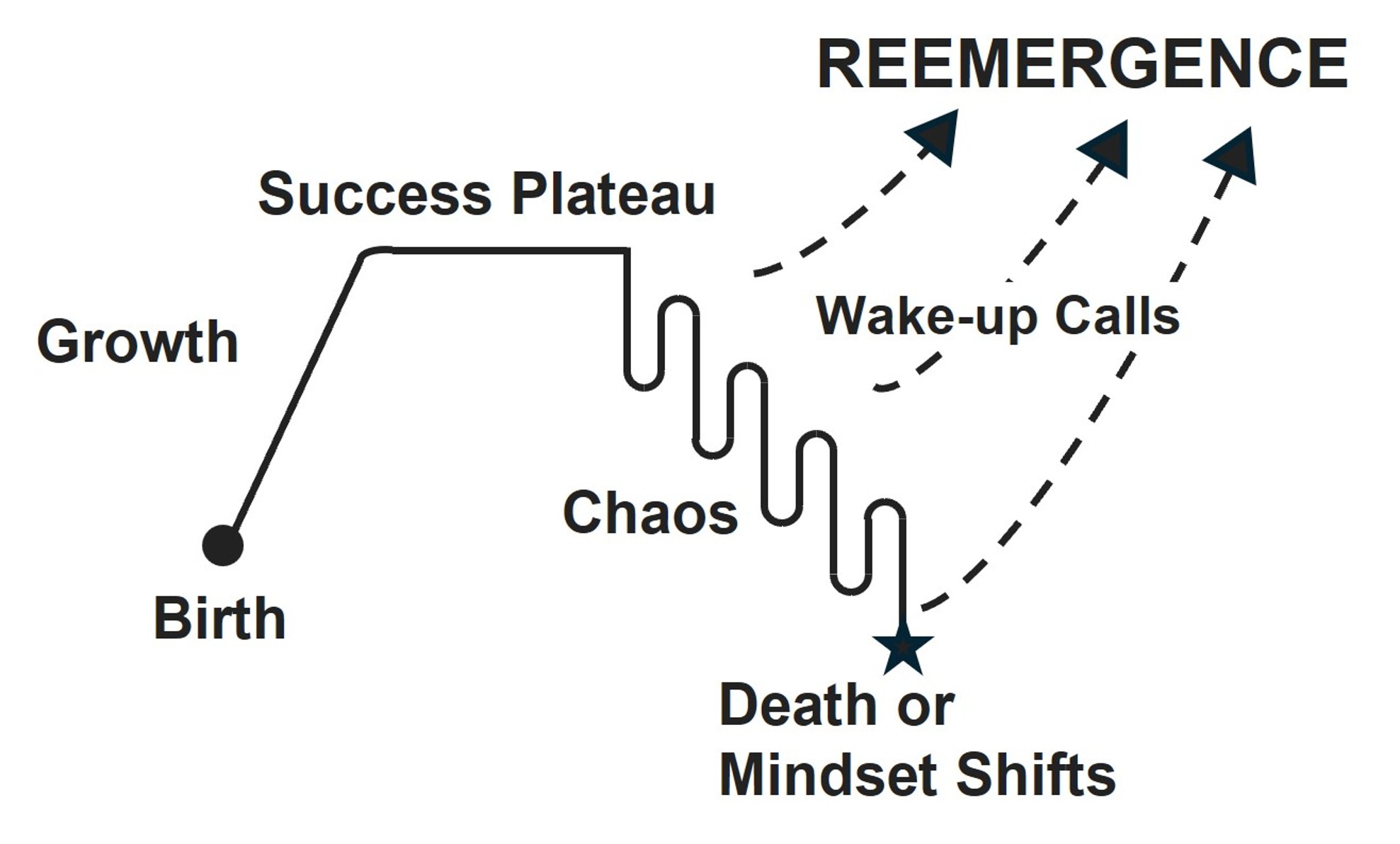
A strategically significant signal that calls into question whether the existing Governing Logic remains fit for purpose. This corresponds to Ackerman’s idea of a wake-up call – recognition that incremental adaptation may no longer be sufficient and that fundamental organisational assumptions may need to be reconsidered.
1 of 72. Develop Hypotheses
Form plausible hypotheses about how the organisation’s Governing Logic might need to change. These describe possibilities to be explored and tested, rather than a predetermined future state.
2 of 73. Enterprise Probes
Conduct bounded, hypothesis-driven experiments to explore how the Governing Logic might need to change. Their purpose is to generate evidence and learning, not to implement a predetermined solution.
3 of 74. Evidence and Learning
Gather and interpret evidence from Enterprise Probes to understand how the organisation responds. Learning informs whether hypotheses should be refined, rejected or developed further.
4 of 75. Evaluate Hypotheses
Assess the evidence to determine whether hypotheses should be rejected, refined and tested further, or are sufficiently supported to progress towards a Change Proposition.
5 of 76. Change Proposition
Translate sufficiently supported learning into a defined proposition for change. Where sufficiently understood, it can progress towards delivery through change initiatives.
6 of 7Continues to adapt the Enterprise System within the existing Governing Logic while transformation is explored. It may range from relatively straightforward to highly complicated and complex change.

Figure best viewed on tablet or above
Figure 4: Second-Order Transformational Change
Enterprise PMO, Strategic PMO And Portfolio Management Office
The PMI practice guide describes the above functions as:
Enterprise PMO
Is a high-level PMO with a broad scope and authority within the organisation. The function is responsible for overseeing and coordinating all PMO activities, ensuring alignment with the organisation’s strategic objectives and providing a consistent approach to project management across the organisation.
Strategic PMO
Focuses on aligning the organisation’s portfolios, programmes, and projects with its strategic objectives and ensuring that they deliver value. The function involves project prioritisation, resource allocation, benefits realisation, and governance. The function typically has a high level of authority within the organisation and works closely with senior management to ensure that the organisation’s project portfolio is effectively managed.
Portfolio Management Office
Is responsible for managing the organisation’s entire portfolio of programmes, projects, and other work. The function oversees the portfolio to ensure alignment with the organisation’s strategy, prioritise investments, and optimise resource allocation. With the highest level of authority and strategic focus, the function plays a crucial role in portfolio management and delivery, ensuring that all initiatives support the overall organisational goals.
Although these terms emphasise different aspects such as enterprise scope, strategic orientation, or portfolio management, they overlap considerably. Each is primarily concerned with enterprise-level alignment, governance, and management of portfolios, programmes, and projects, aligning with PMI’s contemporary PMO conception.
The ECO construct incorporates these concepts rather than replacing them. It maintains an enterprise-wide perspective, strategic alignment, and portfolio governance, but within a different organising framework. Its main focus is developing and stewarding the organisation’s capability for organisational change.
The ECO includes capabilities to govern and support First-Order Change Initiatives and provides the organisational change capability needed to explore Second-Order Transformational Change. Portfolio management is an important ECO capability, but it is not the ECO’s organising framework.
Value Management Office
The PMI practice guide describes a Value Management Office (VMO) as being responsible for ensuring that projects deliver maximum value to the organisation. The VMO focuses on evaluating, prioritising, and tracking project benefits and return on investment (ROI), ensuring projects align with the organisation’s strategic objectives and contribute to its success.
However, these objectives are not unique to the VMO in PMI’s current PMO framework. Value generation is a central theme, explored extensively through the PMO Value Ring™ framework. As a result, the VMO overlaps significantly with PMI’s broader PMO concept.
Other conceptions draw clearer distinctions. For example, the SAFe VMO supports Lean Portfolio Management and focuses on continuous value flow through long-lived value streams, rather than temporary projects. Its distinction lies in how it organises and governs work to create value.
The ECO addresses value concerns from both conceptions but uses a different organising framework. Benefits and value are essential to justifying organisational change and are integral to its governance. However, value management and continuous value flow are not the ECO’s primary focus. Its main concern is developing and stewarding the enterprise capability for organisational change.
Change Management Office
The literature also discusses the Change Management Office (CMO), typically seen as a central function focused on the people-side of change. It develops and supports change-management capabilities, methods, and practices to help leaders and employees engage with, adopt, and sustain changes in ways of working, behaviours, roles, and practices.
The PMI practice guide considers the CMO to be an example of an xMO. The concept is centred on the idea that the PMO’s traditional focus on portfolios, programs, and projects can extend to other areas of the organisation, where management support and expertise can add value. By embracing this broader scope, an xMO can better support the organisation’s strategic objectives, facilitate cross-functional collaboration, and enhance organisational agility.
When a CMO exists alongside a PMO with an expanded remit, clear boundaries are essential. Both may be involved in developing change capability, establishing methods and standards, supporting initiatives, providing expertise, and improving change readiness. Without clear accountabilities, this can lead to duplication, competing methodologies, and ambiguity over responsibility for change-management capability.
The ECO construct aims to reduce fragmentation by providing a common organisational locus to steward and integrate change-specific practices. This is one way to achieve integration; other arrangements may also succeed with clear accountabilities and interfaces. Within the ECO, Change Engagement maintains its focus on the people-side of change but is stewarded alongside Initiative Management and Change Architecture, rather than as a separate function. The goal is not to subsume all expertise within the ECO, but to provide a locus for integrating, developing, and continually improving these complementary practices.
Strategy Execution Office
Crawford (2010) provides a developed example of the argument for positioning an enterprise PMO as a Strategy Execution Office. The PMO links executive strategy and organisational execution: strategy is translated into programmes and projects, the portfolio is selected and prioritised, resources and interdependencies are managed, and performance provides feedback on progress towards strategic objectives. Portfolio management therefore serves as a key bridge between strategy and execution in this model.
This website presents a different view of how strategy is realised. Programmes and projects can deliver strategic value, but their main role in organisational change is to create or adapt capabilities that Operational Continuity then uses. Organisational change is needed when existing capabilities are insufficient to achieve strategic intent: change adapts capability, and Operational Continuity uses capability to realise strategy and value.
This results in distinct but connected responsibilities, as shown in Figure 1 and explored further here. The Strategy Office supports environmental scanning, strategic intelligence, and strategic review, including assessing the suitability of the Governing Logic. The ECO stewards the enterprise capability to conceive, govern, design, deliver, adopt, and sustain organisational change. Operational Continuity uses organisational capabilities to execute strategy and realise value, with experience and performance feeding back into ongoing strategic review.
Figure best viewed on tablet or above
Figure 1: Responsibilities Of Organisational Functions
Each of these functional forms addresses relevant concerns for organisational change, and many of their capabilities are included in the ECO construct. However, none describes the construct without emphasising a particular aspect—such as portfolios, transformation, value, people-side of change, or strategy execution—which risks limiting the function’s intended remit.
The Label Is Secondary, The Construct Is Not
This website does not advocate Enterprise Change Office as the universally correct name for a change-related function. Organisations should use terminology suited to their history, structure, and management arrangements. What matters is that the function’s purpose, scope, capabilities, accountabilities, decision rights, and boundaries are clearly understood.
Enterprise Change Office is not a neutral term. Each word carries its own implications. The term is used here because it does not define the function by a single mechanism, discipline, or aspect of organisational change. Instead, it places organisational change at the centre of the construct and considers capability at the enterprise level.
The word “Office” does not mean that organisational-change capability is contained within a single central function. The capability belongs to, and is distributed across, the enterprise. The ECO provides the organisational locus for its stewardship and integration, convening the capabilities and practices needed to conceive, govern, design, deliver, adopt and sustain organisational change.
That is the distinction the term ECO is intended to preserve.