When Did Transformation Become Just Another Meaningless Buzzword
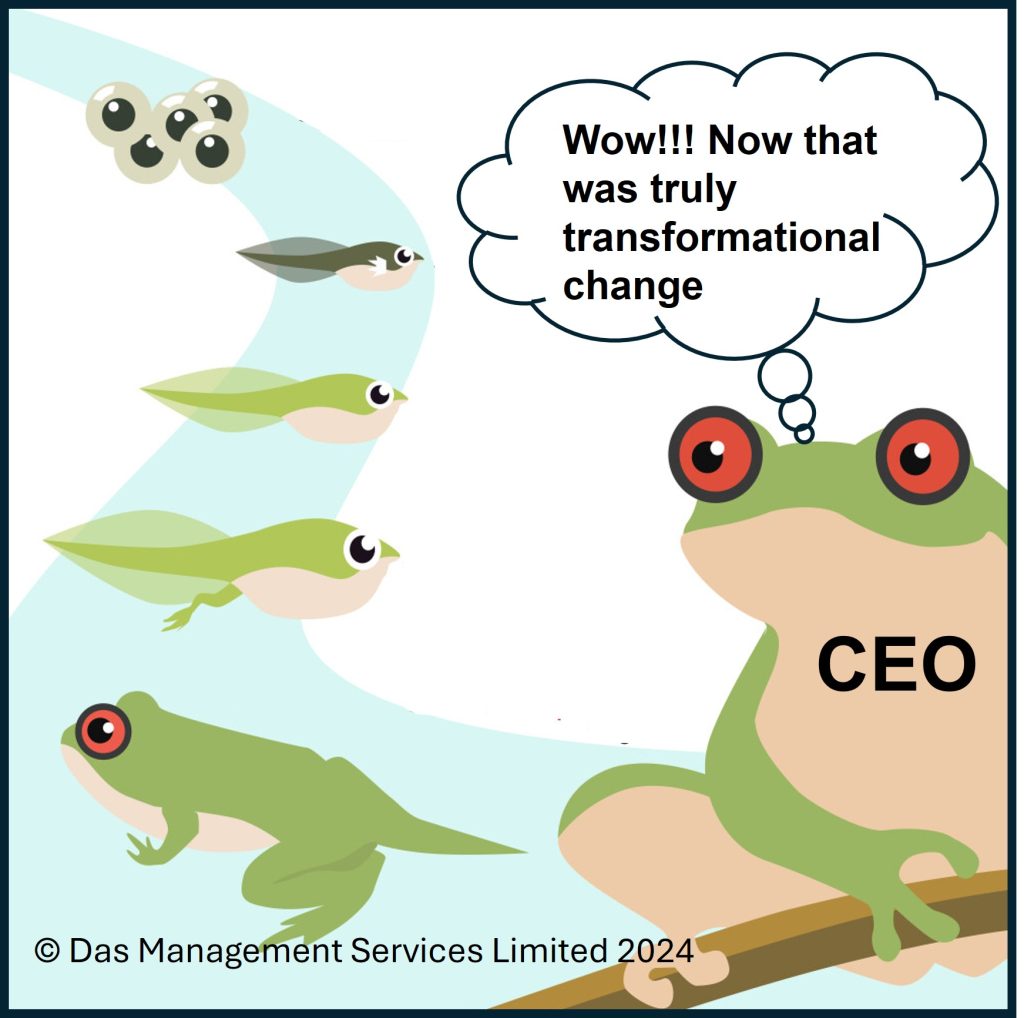
Transformation has become a label applied to almost any organisational change – from privatisation, through ERP implementations and restructures, to digitalisation and cost reduction. But scale, complexity and disruption do not, by themselves, make change transformational. This leads us to a simple test for any claim of transformation:
If this is genuinely transformational, in what fundamental sense will this be a different organisation when it is complete?
Contents
Introduction
I first encountered the term ‘transformation’ while studying for my MBA at the University of Cape Town in the late 1980s. At that time, South Africa was on the brink of significant political change, which also signalled the potential for major shifts in how public and private sector organisations operated.
During my studies, I was exposed to the work of Paul Watzlawick and his colleagues, as well as Amir Levy, Jean Bartunek, Michael Moch, and, most relevant here, Linda Ackerman.
In subsequent years, my understanding of First-Order and Second-Order Change deepened through work with organisations in diverse contexts, including England’s newly privatised water and rail sectors, EU accession preparations in Romania, and organisational culture change in the Middle East.
Over time, the language has shifted significantly. Transformation is now applied to a broader range of organisational changes.
The Roots Of Transformational Change
Before exploring how these thinkers differentiated organisational change, it is helpful to clarify the ordinary meanings of four recurring terms, as shown in Figure 1.
| Development | The process in which someone or something grows or changes and becomes more advanced. |
| Transition | A change from one form or type to another, or the process by which this happens. |
| Reinvention | The act of producing something new based on something that already exists, or the new thing that is produced. |
| Transformation | A complete change in the appearance or character of something or someone, especially so that that thing or person is improved. |
Source: Cambridge Dictionary
Figure best viewed on tablet or above
Figure 1: Dictionary Definitions
These definitions indicate increasingly fundamental forms of change, but they do not form a theory of organisational change. For that, it is useful to return to the earlier thinkers and their work distinguishing change within an existing organisational order from change to that order.
Paul Watzlawick And The Two Orders Of Change
Paul Watzlawick and his colleagues distinguished between First-Order Change, which occurs within an existing system while its underlying rules remain intact, and Second-Order Change, which alters the rules or assumptions governing the system. This distinction, first developed in systems thinking and psychotherapy, was later applied to organisations. Discover More
Amir Levy And Second-Order Change
Amir Levy applied the distinction between First-Order and Second-Order Change to organisations. He linked Second-Order Change to organisational transformation, describing it as multidimensional, multilevel, qualitative, and discontinuous, involving a shift in the organisation’s underlying paradigm. Thus, he distinguished transformation by the nature of change, not merely its scale. Discover More
Jean Bartunek And Michael Moch And The Orders Of Change
Jean Bartunek and Michael Moch introduced a cognitive perspective on organisational change, focusing on shared schemata that shape how members interpret events. They defined First-Order Change as occurring within existing schemata, Second-Order Change as modifying those schemata, and Third-Order Change as the ability to recognise and alter schemata when needed. Discover More
Linda Ackerman And Three Types Of Change
Linda Ackerman identified three types of change. Developmental Change improves existing conditions, Transitional Change moves toward a defined new state, and Transformational Change is qualitatively different, resulting in a fundamentally new organisational state that cannot be fully specified in advance. This distinction separates transformation from both organisational improvement and implementing a predetermined future state. Discover More
Despite differing perspectives, these thinkers agree on a key point: fundamental organisational change is not defined by the amount, scale, or difficulty of change. It involves altering the rules by which a system operates, its organisational paradigm, the schemata through which it is understood, or the resulting organisational state.
This distinction between change within an existing organisational order and change to that order provides the conceptual foundation for the distinction between First-Order System Change and Second-Order Transformational Change developed within this website.
When Did Transformation Become Diluted?
The Cambridge Dictionary defines a buzzword as:
“A word or expression from a particular subject area that has become fashionable by being used a lot.”
A buzzword is not inherently meaningless; the article’s title is intentionally provocative. The issue arises when a term is used so broadly that it no longer meaningfully distinguishes between different phenomena.
Figure 3 illustrates the broad progression in how the term came to be used.
| Period | Development |
|---|---|
| 1980s | Academic and Organisation Development thinking developed organisational transformation as a concept associated with fundamental, qualitative change to the organisation itself, distinct from improvement or change occurring within an existing organisational order. |
| 1990s | The rapid growth of Enterprise Resource Planning (ERP) brought large, complicated and organisationally disruptive change. ERP implementations were increasingly framed as business transformation rather than simply systems implementation. Processes, roles and ways of working could change substantially while the underlying organisational order remained intact. Transformation was therefore increasingly being associated with the scale and difficulty of change, rather than necessarily with a different order of change. |
| 2000s/2010s | Digital transformation became widely used for technology-enabled organisational change, while the terminology spread to HR, finance, procurement, ERP and operating-model transformation. Transformation increasingly became a marker of scale, ambition or strategic significance rather than necessarily identifying a distinct order of organisational change. |
| 2020s | Transformation became increasingly ubiquitous as organisations pursued overlapping digital, AI, sustainability and operating-model change. Multiple concurrent “transformations” became commonplace, while terms such as Reinvention began to be used to describe more fundamental forms of organisational renewal. |
Figure best viewed on tablet or above
Figure 3: The Changing Use Of Transformation
Many of these initiatives are valuable and strategically important. The concern is classification, not merit. When organisations use Transformation for any significant change, it loses its ability to distinguish truly fundamental change.
What Does Transformation Mean Today?
When Everything Becomes Transformation
Transformation is widely used in contemporary practitioner literature, often alongside other management concepts. What makes the change itself transformational is not always made explicit.
References to Minor and Major Transformation appear to distinguish transformation principally by scale. But if Transformation identifies a different order of organisational change, scale alone cannot determine whether change is transformational. A very large change can remain First-Order, while the significance of Second-Order Change lies in what becomes subject to change, not simply how much change occurs.
Transformation Programmes and portfolios of Transformation Programmes are also commonplace. Programme management can provide an appropriate means of delivering sufficiently understood elements arising from a transformation. The difficulty arises when Transformation itself is treated as a programme: Second-Order Change may require hypotheses about the future organisation to be explored and tested before many of the required changes can be sufficiently specified for programme or project delivery. Transformation may generate programmes. It is not itself a programme.
Transformation Offices have also emerged, frequently undertaking activities associated with Programme or Portfolio Management Offices: coordinating initiatives, managing dependencies, reporting progress and supporting governance. These can be valuable organisational capabilities but calling the coordinating function a Transformation Office tells us little about whether the changes it coordinates are themselves transformational.
Strategic Transformation presents another challenge. If Transformation denotes fundamental organisational change, it should already have strategic significance. Unless “Strategic” identifies an additional characteristic, the qualifier adds emphasis rather than analytical precision.
Continuous Transformation poses a significant conceptual issue. Organisations may continually adapt, experiment, and improve, but ongoing change is not necessarily continuous Transformation. If Transformation refers to changes in the underlying organisational order, treating all adaptation as transformational erases the distinction between First-Order and Second-Order Change.
Metamorphosis can represent true transformation. The key question is whether all organisational changes labelled as transformational genuinely meet this standard.
Concerns about the dilution of Transformation are also raised in current practitioner commentary. Deutscher (2025), writing in Forbes, argues that Transformation has become a buzzword and should be reserved for fundamental change. Haas (2023) similarly notes that the term has become so vague it can mean “anything or nothing.” While such commentary highlights the issue, the greater challenge is defining what sets Transformational Change apart from other significant organisational changes.
From Transformation to Reinvention
Recent consultancy usage offers clear examples of this shift in terminology. McKinsey provides an instructive progression:
- Bucy et al. (2016) describe Transformation as “perhaps the most overused term in business,” criticising its use for minor or routine changes. Their definition focuses on intensive, organisation-wide programmes aimed at improving performance and organisational health. Such changes may be extensive and consequential without altering the organisation’s underlying order.
- More recently, De Smet et al. (2025) introduced Reinvention as a fourth and more fundamental level of change, beyond Execution, Mobilising, and Transformation. They argue that Reinvention challenges the organisation’s identity, value creation, and core purpose.
Baarsma et al. (2026) offer a similar perspective. In PwC’s The Reinvention Premium, they argue for a shift “from transformation to reinvention.” Reinvention requires fundamentally rethinking multiple elements of the business model and changing “the logic of how the company competes,” positioning it as a more fundamental change than Transformation.
This creates an interesting inversion of the ordinary meanings shown in Figure 1. Reinvention involves producing something new from what already exists, whereas Transformation implies a complete change in character. Yet both McKinsey and PwC now use Reinvention for forms of fundamental change that bear a striking resemblance to characteristics earlier associated with Transformational or Second-Order Change.
It would not be surprising to see Reinvention Offices emerge soon, managing portfolios of Major and Minor Reinvention.
This progression shows how the concept of Transformation has evolved. As the term expanded to include substantial First-Order Change, it lost its ability to distinguish the more fundamental changes described by earlier theories. Reinvention now appears to occupy some of this conceptual space.
The Problem Is Classification, Not Importance
The changes described by these labels may be highly consequential. Major programmes, technology implementations, operating-model redesigns and continuous improvement can all be strategically important. The issue is not their importance but their classification. Once Transformation can describe Second-Order Change, a large First-Order initiative, a portfolio of projects, an organisational function and an ongoing state of adaptation, the term tells us progressively less about the nature of the change taking place.
But Has the World Changed?
First-Order and Second-Order Change emerged in a very different organisational era. Do complexity, continuous change and concepts such as BANI make the distinction obsolete?
Explore The Challenge
Why Is The Buzzword Language So Attractive?
If terms like Transformation are so imprecise, why do they persist? Their ambiguity can be useful, as they convey importance and ambition without requiring precise agreement on what is changing.
Transformation signals significance. A Transformation Programme seems more consequential than a standard programme, and a Transformation Office implies a broader mandate. The progression can become familiar: an initiative becomes a programme, the programme becomes a Transformation Programme, and eventually a Transformation Office is needed to oversee a portfolio of transformations. This escalation in language can make initiatives appear more significant, even if the underlying change remains largely the same.
The language can also mobilise. Terms like Transformation, Reinvention, and Strategic Transformation suggest movement toward significant change and create a stronger narrative than terms such as systems implementation or process redesign. For leaders seeking attention and commitment, this rhetorical power is clear.
Ambiguity offers another advantage. Stakeholders can interpret the same label differently while appearing to support a common goal. Transformation can include technology modernisation, cost reduction, operating model redesign, cultural change, and strategic repositioning without requiring initial agreement on whether these changes form a coherent whole.
The qualities that make buzzword language attractive also reduce its analytical value. A term can signal ambition and mobilise attention because it allows for multiple interpretations. The problem arises when such language is expected to provide a precise basis for diagnosing, governing, and delivering organisational change.
Why Does the Language Matter?
It may seem this is merely a debate over terminology. However, language shapes how people understand organisational change, the expectations it sets, and how it is approached and managed.
Language can affect credibility. Repeatedly labelling organisational change as Transformation, especially when employees see little fundamental change, can lead to scepticism. Brown et al. (2017) found that frequent exposure to organisational change increases cynicism. While their research did not focus on transformational language, it highlights the need to use grand transformational terms with caution.
Language can also obscure the type of change underway. Second-Order Change may be mistaken for a larger or more complex First-Order initiative. When the organisational order is questioned, identifying what should replace it becomes part of the process. Projects and programmes can deliver well-understood elements, but treating transformation as a programme risk creating false certainty where exploration and learning are still needed.
The issue is more than semantic. Overusing transformational rhetoric can undermine credibility, and applying the same label to different types of change can obscure important distinctions. Greater precision does not make change easier, but it helps organisations understand and respond to the change they face.
A More Useful Way of Classifying Change
For Transformation to retain analytical value, organisational change must not be classified solely by scale, cost, complexity, or strategic importance. The key distinction is the order at which change occurs.
The distinction between First-Order and Second-Order Change developed by the thinkers discussed earlier provides the foundation. Building on that distinction, this website differentiates between First-Order System Change and Second-Order Transformational Change.
To clarify this distinction at the enterprise level, two concepts are used: the Enterprise System and Governing Logic. The Enterprise System includes the organisational capabilities and arrangements through which the organisation operates, such as Culture, Business Model, Value Chain, and Operating Model. Governing Logic refers to the underlying principles and assumptions that guide fundamental choices about value creation, identity, authority, strategy, resource allocation, and accountability. These constructs are further described here.
First-Order System Change adapts the Enterprise System while the Governing Logic remains intact. Second-Order Transformational Change occurs when the Governing Logic itself is reconsidered and potentially changed.
Second-Order Transformational Change
Second-Order Transformational Change should be relatively rare, but the strategic process should explicitly test whether the existing Governing Logic can still support the organisation’s strategic intent. The need to reconsider it may also emerge between formal strategic reviews as the organisation learns from changes in its environment and from experience in pursuing strategy.
As discussed earlier, Ackerman’s Transformational Change is interpreted within this framework as Second-Order Transformational Change. Making Governing Logic an explicit subject of strategic consideration increases the organisation’s ability to recognise when such fundamental change may be required.
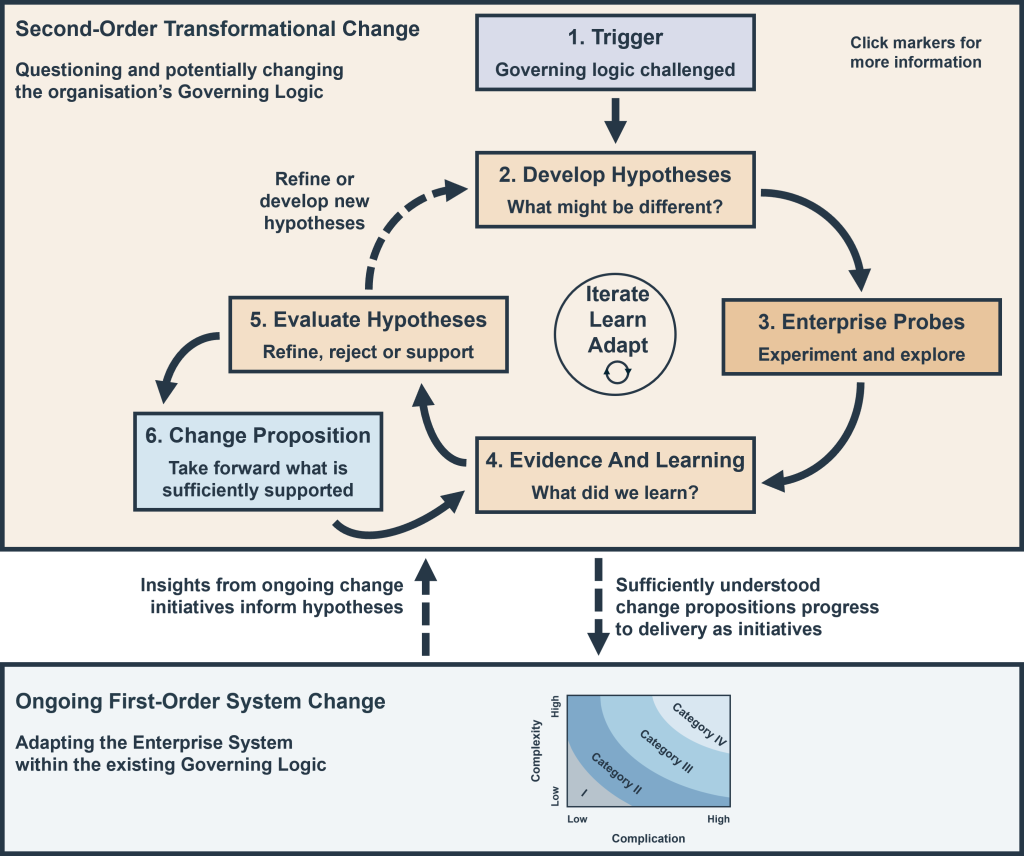
When the future Governing Logic cannot be specified with confidence, traditional programme and project methods are insufficient. Instead, Enterprise Probes—deliberate experiments and inquiries—can explore hypotheses about necessary changes to Governing Logic. Evidence and learning help refine or support these hypotheses. Well-supported hypotheses become Change Propositions, which, once understood, can move toward delivery through change initiatives. Figure 4 illustrates this process.
1. Trigger
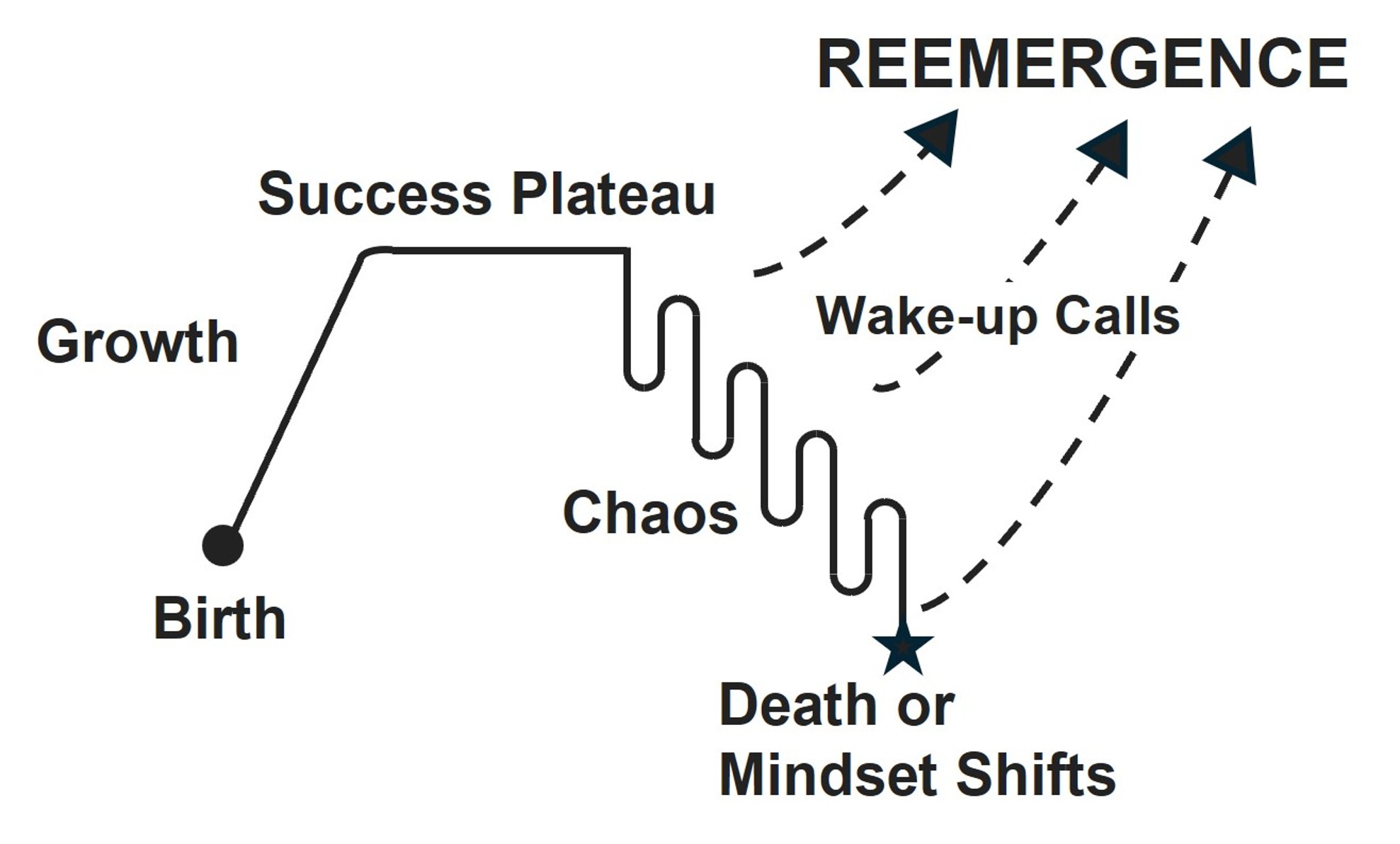
A strategically significant signal that calls into question whether the existing Governing Logic remains fit for purpose. This corresponds to Ackerman’s idea of a wake-up call – recognition that incremental adaptation may no longer be sufficient and that fundamental organisational assumptions may need to be reconsidered.
1 of 72. Develop Hypotheses
Form plausible hypotheses about how the organisation’s Governing Logic might need to change. These describe possibilities to be explored and tested, rather than a predetermined future state.
2 of 73. Enterprise Probes
Conduct bounded, hypothesis-driven experiments to explore how the Governing Logic might need to change. Their purpose is to generate evidence and learning, not to implement a predetermined solution.
3 of 74. Evidence and Learning
Gather and interpret evidence from Enterprise Probes to understand how the organisation responds. Learning informs whether hypotheses should be refined, rejected or developed further.
4 of 75. Evaluate Hypotheses
Assess the evidence to determine whether hypotheses should be rejected, refined and tested further, or are sufficiently supported to progress towards a Change Proposition.
5 of 76. Change Proposition
Translate sufficiently supported learning into a defined proposition for change. Where sufficiently understood, it can progress towards delivery through change initiatives.
6 of 7Continues to adapt the Enterprise System within the existing Governing Logic while transformation is explored. It may range from relatively straightforward to highly complicated and complex change.
Figure best viewed on tablet or above
Figure 4: Second-Order Transformational Change
When the future Governing Logic cannot be specified with confidence, traditional programme and project methods are insufficient. Instead, Enterprise Probes—deliberate experiments and inquiries—can explore hypotheses about necessary changes to Governing Logic. Evidence and learning help refine or support these hypotheses. Well-supported hypotheses become Change Propositions, which, once understood, can move toward delivery through change initiatives. Figure 4 illustrates this process.
Managing both simultaneously requires Organisational Ambidexterity: the ability to continue operating and adapting within the existing organisational order while exploring the fundamentally different order that may be required for the future.
The National Health Service in England illustrates the kind of situation in which Second-Order Transformational Change might need to be considered. Many of its challenges can undoubtedly be addressed through First-Order System Change. Persistent questions about how healthcare is organised, funded, governed and delivered may, however, require examination of assumptions underlying the existing organisational order. The diagnostic question is therefore not whether the NHS needs larger programmes successively, but whether its existing Governing Logic can still support what society requires of it.
First-Order System Change
First-Order System Change is likely to recur and, in many organisations, is effectively continuous. It adapts Culture, Business Model, Value Chain, and Operating Model within the existing Governing Logic.
As discussed earlier, Ackerman’s Developmental and Transitional Change are interpreted within this framework as forms of First-Order System Change. That distinction, however, does not adequately differentiate First-Order Change across the management challenges created by complicatedness and complexity. Here:
- Complicatedness is the degree to which change is difficult because of the number, variety and interdependence of elements that must be understood, designed, coordinated and implemented. Complicatedness can generally be addressed through analysis, expertise, decomposition and planning, even where doing so is demanding.
- Complexity is the degree to which change is difficult because interactions between elements, people and their environment produce responses and outcomes that cannot be confidently predicted in advance. Complexity therefore requires feedback, learning, and adaptation rather than relying solely on analysis and predetermined plans.
Practically, the distinction can be stated simply:
“Complicatedness concerns how difficult the change is to analyse and coordinate; complexity concerns how difficult its consequences are to predict.”
This distinction is important because it prevents complexity from being equated with ‘big and difficult.’ For example, a large ERP implementation may be highly complicated but not complex. Conversely, a modest change involving many autonomous actors and unpredictable responses can be highly complex without being complicated.
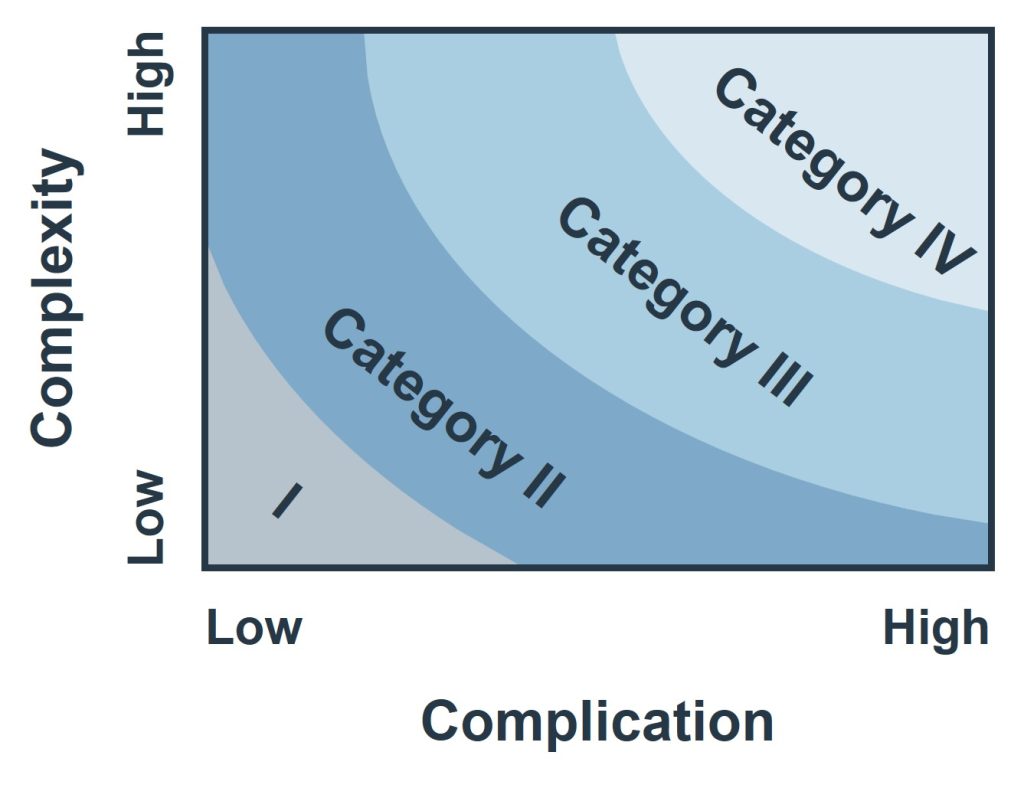
Rather than using the terms “Developmental” and “Transitional”, this website suggests that organisations categorise First-Order System Change along a continuum of four categories as shown in Figure 5.
Figure best viewed on tablet or above
Figure 5: Continuum Of Categories Of First-Order System Change
The boundaries between these categories are not universal thresholds but form a continuum based on each organisation’s assessment of the change, its environment, and capabilities. Their purpose is to guide governance and approach decisions, not to create a hierarchy of importance. The organisation should clearly communicate the rationale for categorisation.
Category I change, with low complication and complexity, focuses on improving or developing existing conditions. Category II involves more substantial movement toward a future state that remains sufficiently knowable to design and plan. Category III, with higher complexity, requires ongoing feedback, learning, and adjustment. Category IV combines high complication and complexity, requiring extensive coordination while recognising that not all interactions and outcomes can be predicted.
Importantly, Transformational Change is outside this categorisation. Increasing complicatedness or complexity does not turn First-Order System Change into Second-Order Transformational Change. The latter is a different order of change because the Governing Logic itself is reconsidered.
The framework is diagnostic, not mechanical. It does not remove uncertainty or prescribe a single method for managing change. Its purpose is to help organisations distinguish between different orders and conditions of change before deciding how to govern and approach them.
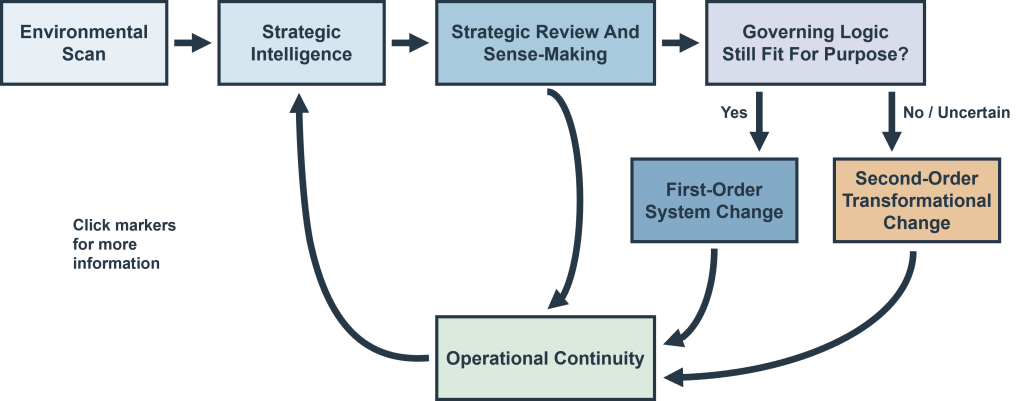
In practice, determining the order of change is part of a broader strategic process. Environmental scanning and evidence from Operational Continuity – the ongoing use of organisational capabilities to fulfil purpose and create value – contribute to Strategic Intelligence, which informs strategic review and sense-making.
When organisational change is needed, a key question is whether the existing Governing Logic remains fit for purpose. If it does, adaptation can proceed through First-Order System Change. If not, or if its suitability is uncertain, Second-Order Transformational Change may be required. Figure 6 illustrates this relationship.
Environmental Scan
Systematic consideration of developments in the internal and external environment that may affect strategic intent, assumptions or future capability requirements. Relevant signals feed into Strategic Intelligence alongside evidence and learning from within the organisation.
1 of 7Strategic Intelligence
Synthesises relevant internal and external signals with evidence and learning from Operational Continuity to inform strategic review and sense-making.
Strategic Review and Sense-Making
Reviews strategic intelligence to reassess strategic intent, assumptions, priorities and required capabilities, while testing whether the existing Governing Logic remains fit for purpose.
3 of 7Governing Logic Fit
Tests whether the organisation’s existing Governing Logic remains capable of supporting its strategic intent. If it does, required change remains First-Order System Change; if not, or if sufficiently uncertain, Second-Order Transformational Change may be required.
4 of 7First-Order Change
Adapts the Enterprise System within the existing Governing Logic. It may range from relatively straightforward change to highly complicated and complex change, but does not require the underlying Governing Logic itself to change.
5 of 7Second Order Change
Reconsiders and potentially changes the organisation’s Governing Logic when it can no longer be assumed fit for purpose. Where the future logic is uncertain, hypotheses are developed and tested through Enterprise Probing, allowing an emerging future state to be progressively understood.
6 of 7Operational Continuity
The continuing use of organisational capabilities through which the organisation fulfils its purpose and creates value. It provides the principal means through which strategy is executed and generates evidence and learning that feed back into Strategic Intelligence.
7 of 7Figure best viewed on tablet or above

Figure 6: Determining the Order of Organisational Change
Figure 6 also shows that strategic review does not always lead to organisational change. If existing capabilities are sufficient, the organisation continues its strategy through Operational Continuity. If capabilities must change but the Governing Logic remains fit for purpose, First-Order System Change is appropriate.
If the Governing Logic is no longer fit for purpose, or its suitability is uncertain, Second-Order Transformational Change may be needed. The future Governing Logic should not be assumed to be a predetermined target state; instead, it must be explored and understood as the organisation learns what new order may be required.
The Role Of An Enterprise Change Office
An Enterprise Change Office (ECO), as described here, extends the traditional PMO by focusing on organisational change as an enterprise capability, not just projects and programmes. Its purpose is not to label initiatives as transformational, but to help the organisation distinguish between different orders and conditions of change and ensure each is governed and supported appropriately.
A single enterprise capability can support both orders of change without treating them as requiring the same response. For First-Order System Change, the ECO ensures consistent assessment of complicatedness and complexity and selects appropriate governance and delivery approaches. If strategic review or organisational learning suggests the Governing Logic may no longer be fit for purpose, the ECO can support Enterprise Probing by assembling expertise to develop and test hypotheses, gather evidence, and turn well-supported hypotheses into Change Propositions. Once understood, these can be delivered through projects, programmes, or other initiatives.
This approach allows Second-Order Transformational Change to be explored while First-Order System Change continues in parallel, without forcing both into a single delivery model. Enterprise Probes are not conventional change initiatives, but they require funding, capacity, and leadership attention. They should be visible in the enterprise change portfolio for prioritisation and governance, given their exploratory purpose.
This broader remit does not make the ECO responsible for strategy or give it authority over the organisation’s Governing Logic. Executive leadership remains accountable for strategic intent and decisions about changes to Governing Logic. The ECO does not need to own every discipline involved in change; its role is to integrate and support required capabilities, bring together expertise, and provide an enterprise-wide view, without assuming all changes require the same governance or delivery approach.
References
Ackerman, L. S. (1986) ‘Development, Transition, or Transformation: The Question of Change in Organizations’, OD Practitioner, 18(4), pp. 1–8.
Ackerman Anderson, L. (2016) ‘Organization Development and Transformation: What It Takes’, in Rothwell, W.J., Stavros, J.M. and Sullivan, R.L. (eds.) Practicing Organization Development: Leading Transformation and Change. 4th edn. Hoboken, NJ: John Wiley & Sons, pp. 60–78
Bartunek, J. M. & Moch, M. K. (1987) ‘First-Order, Second-Order, and Third-Order Change and Organization Development Interventions: A Cognitive Approach’, The Journal of Applied Behavioral Science, 23(4), pp. 483–500.
Brown, M., Kulik, C. T., Cregan, C. & Metz, I. (2017) ‘Understanding the Change-Cynicism Cycle: The Role of HR’, Human Resource Management, 56(1), pp. 5–24.
Bucy, M., Hall, S. & Yakola, D. (2016) ‘Transformation with a capital T’, McKinsey Quarterly, 7 November. Available at: Transformation with a capital T (Accessed: 27 August 2026).
De Smet, A., Gast, A., Mandersloot, E. & Steele, R. (2025) ‘Change is changing: How to meet the challenge of radical reinvention’, McKinsey Quarterly, 19 November. Available at: Change is changing: How to meet the challenge of radical reinvention (Accessed: 27 August 2026).
Deutscher, A. (2025) ‘Stop using the word “transformation” if you don’t really mean it’, Forbes, 12 February. Available at: Stop using the word “transformation” if you don’t really mean it (Accessed: 1 September 2026).
Haas, R. (2023) ‘Transformation: buzzword between aspiration and reality’, Oseon, 27 July. Available at: Transformation: buzzword between aspiration and reality (Accessed: 1 September 2026).
Levy, A. (1986) ‘Second-Order Planned Change: Definition and Conceptualization’, Organizational Dynamics, 15(1), pp. 5–23.
Levy, A. & Merry, U. (1986) Organizational Transformation: Approaches, Strategies, and Theories. New York: Praeger.
Watzlawick, P., Weakland, J. H. & Fisch, R. (1974) Change: Principles of Problem Formation and Problem Resolution. New York: W. W. Norton & Company.