The Enterprise Change Office

The Construct Of An Enterprise Change Office

Managing individual initiatives does not equate to driving organisational change. An Enterprise Change Office offers an integrated approach to building and sustaining this capability.

Organisational Change Requires an Enterprise Capability

Organisational change involves adapting an organisation’s Enterprise System and, where necessary, its Governing Logic to realise its strategy and objectives. As discussed here, managing individual changes effectively does not necessarily provide the enduring enterprise capability needed to undertake change across the organisation over time.

Multiple Change Initiatives may be well managed individually but can compete for resources, create conflicting demands, duplicate benefits, or exceed the organisation’s capacity for change. Addressing these challenges requires an integrated enterprise capability that ensures visibility, develops effective practices and practitioner skills, and enables systematic learning.

The Enterprise Change Office Construct

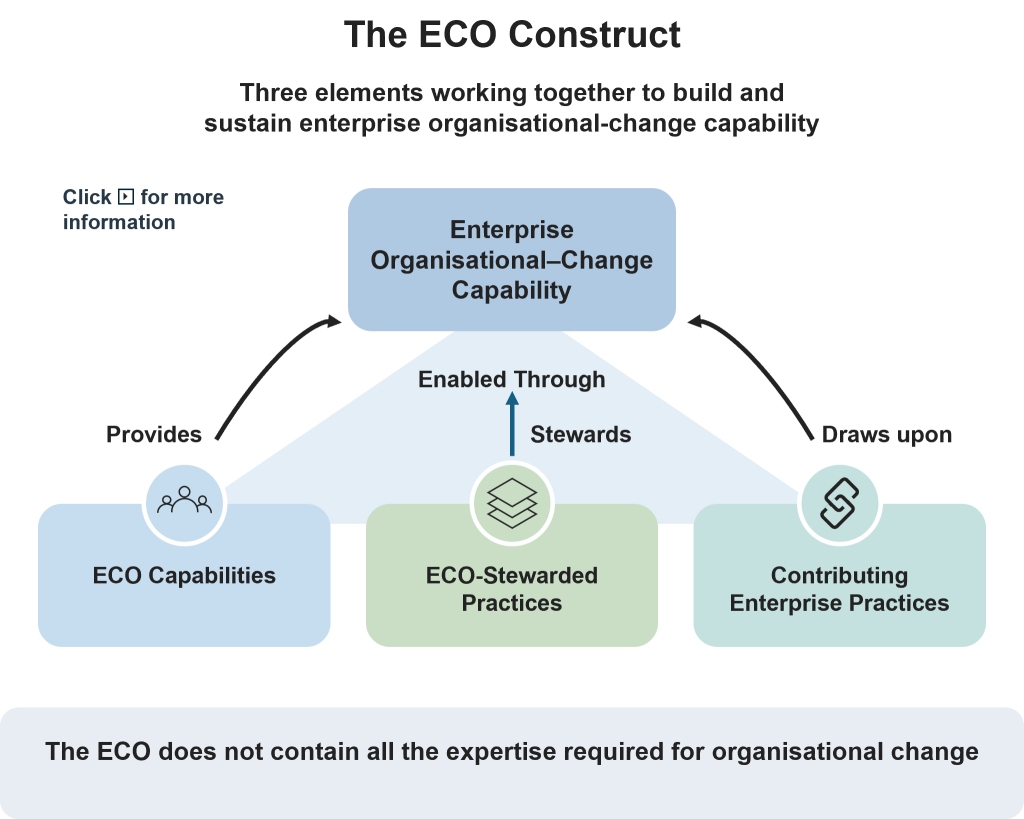
Figure 1 illustrates the ECO construct developed on this website. It focuses on the enterprise’s capability for organisational change, not on managing individual Change Initiatives. It distinguishes between the enterprise-level capabilities the ECO develops, the organisational-change practices it stewards, and the broader enterprise practices that support effective change.

A more change-capable enterprise that can adapt its Enterprise System and, where necessary, its Governing Logic, to realise its strategy and objectives.

1 of 5

What the ECO itself provides at enterprise level.

2 of 5

Change-specific bodies of practice whose development and stewardship sit with the ECO.

3 of 5

Specialist expertise from elsewhere in the enterprise, depending on the nature of the organisational change.

4 of 5

The ECO stewards change-specific practices, provides enterprise change capabilities, and enables relevant Contributing Enterprise Practices to be brought together according to the change being undertaken.

5 of 5


Figure best viewed on tablet or above

Figure 1: The Enterprise Change Office Construct

The construct also identifies key roles in organisational change, including Sponsors, Initiative Managers, Change Architects, Change Engagement practitioners, Benefits practitioners, and Business Change Managers.

ECO Capabilities

The ECO construct defines four interdependent capabilities for developing and sustaining enterprise organisational-change capability: Enterprise Change Intelligence, Governance & Decision Support, Practice Development & Knowledge Stewardship, and Leadership & Capability Development.

Together, these capabilities enable understanding, governance, support, and continuous improvement of organisational change. They deliver activities such as initiative mobilisation, assurance, portfolio analysis, and enterprise benefits oversight as integrated functions.

ECO-Stewarded Practices

The ECO construct identifies four practices for which the ECO provides enterprise-wide stewardship: Initiative Management, Change Architecture, Change Engagement, and Benefits Management. These practices focus on organisational change, are distinct and repeatable, benefit from enterprise-wide development and learning, and have no more suitable organisational home.

Stewardship involves developing and maintaining principles, methods, role expectations, guidance, practitioner capability, and organisational learning. The ECO does not perform all activities related to these practices; practitioners primarily apply them within Change Initiatives and other organisational-change activities.

Contributing Enterprise Practices

The ECO construct distinguishes ECO-Stewarded Practices from Contributing Enterprise Practices. The ECO does not include all specialist expertise required for organisational change. Change Initiatives and Enterprise Probes draw on established enterprise practices such as Finance, Human Resources, Technology and Data, Risk, Legal and Commercial, depending on the change requirements.

Supporting Two Orders of Organisational Change

The ECO construct recognises two orders of organisational change. First-Order System Change adapts the Enterprise System within the organisation’s existing Governing Logic. It is carried out through authorised Change Initiatives, supported by established lifecycle governance, delivery practices and arrangements for adoption and benefits realisation.

Second-Order Transformational Change occurs when the organisation’s Governing Logic is uncertain or needs reconsideration. It involves questioning assumptions, exploring alternative ways of operating and testing hypotheses through Enterprise Probes. These activities require governance suited to uncertainty and learning, rather than the conventional governance used for authorised Change Initiatives.

A Strategy Office supports strategic sense-making, develops and evaluates hypotheses, and scopes, authorises and reviews Enterprise Probes. The ECO contributes organisational-change expertise to their design, coordination and evaluation, drawing on ECO-Stewarded and Contributing Enterprise Practices as needed. Executive leadership retains decisions about the organisation’s Governing Logic.

What The Enterprise Change Office Does - And Does Not Do

The ECO develops and sustains the enterprise’s capability for organisational change. Its responsibilities are distinct from those of governance bodies, initiative teams, a Strategy Office and Operations. Figure 2 clarifies its scope and boundaries.

The ECO Develops And Maintains The ECO Does Not
Develops and sustains enterprise organisational-change capability, including common practices, methods, guidance and practitioner development. Assumes responsibility for managing individual Change Initiatives or replaces their Sponsors, Initiative Managers and teams.
Maintains governance processes, provides decision support, assurance and enterprise change intelligence. Exercises the investment, authorisation or continuation decisions reserved for delegated governance bodies.
Stewards Initiative Management, Change Architecture, Change Engagement and Benefits Management as enterprise practices. Undertakes all activities associated with these practices or assume the responsibilities of appointed practitioners.
Facilitates access to relevant specialist expertise and supports its effective contribution to organisational change. Replaces established enterprise disciplines or directly manages their contributions within individual initiatives.
Maintains enterprise-wide visibility of change, dependencies, capacity, expected benefits and learning. Assumes operational accountability for adoption, sustained use of new capabilities or benefits realisation.

Figure best viewed on tablet or above

Figure 2: Understanding The Enterprise Change Office’s Boundaries

The Enterprise Change Office Within The Organisation

The ECO operates within a broader set of organisational relationships that connect strategy, organisational change, and Operational Continuity. The Strategy Office supports strategic direction and assesses whether the organisation’s Enterprise System and Governing Logic remain fit for purpose. Governance bodies exercise delegated decision-making authority, while the ECO provides the capability, intelligence and support required for effective organisational change.

Sponsors and Initiative Managers lead Change Initiatives, drawing on specialist expertise and affected operational areas. Operations maintain ongoing performance, adopt new capabilities and sustain their use to realise benefits. The ECO connects and supports these activities through its capabilities and stewarded practices, without assuming the responsibilities of the Strategy Office, governance bodies, initiative teams or Operations.

Establishing a Minimum Viable Enterprise Change Office

Establishing an ECO does not require creating a large new function. Most organisations already have elements of organisational-change capability distributed across existing functions, teams and individuals. The starting point is to assess the adequacy of those capabilities, identify material gaps and determine how existing resources and expertise can be brought together more effectively.

A Minimum Viable ECO can be established with a limited set of responsibilities, resources and capabilities appropriate to the organisation’s change requirements. Its scope and maturity can then develop incrementally, informed by experience, evidence of effectiveness and evolving change portfolio demands.

Explore More

From Strategy To Organisational Change

How strategic intent is translated into Business Needs, organisational-change priorities and the capabilities required to realise the organisation's objectives.

Why Use the Term Enterprise Change Office?

Why this website adopts the Enterprise Change Office terminology, how it differs from established approaches, and why the function's purpose matters more than its name.

Assessing Your Organisation’s Change Capability

How to determine whether the organisation can govern, undertake, adopt, and sustain change across its portfolio, and identify where improvement is needed.

The Agile And Lean Enterprise Change Office

Organisational change is defined in many different ways. Explore the definition adopted by this website and the reasoning behind it.
error: Content is protected !!

The Potential Weaknesses Of An Organisational Change Playbook

Some of the potential weaknesses of an Organisational Change Playbook and possible mitigations are addressed below.

Potential Weakness Mitigation
Bureaucracy and unnecessary work Lean processes, proportionate governance, and only the documentation necessary.
Rigidity and reduced agility Explicit tailoring provisions, alternative approaches and professional judgement within defined governance boundaries.
False confidence in competence Defined competence requirements, appropriate training, specialist support, assurance and escalation arrangements.
Outdated or ineffective guidance Accountable stewardship, regular review, feedback from practice and evidence-based improvement.
Fragmentation and duplication A coherent process architecture linking activities, decisions, responsibilities, methods and information.
Limited use in practice Integrate with normal management activities, provide accessible guidance, set leadership expectations, and offer practical support.
Disproportionate costs Assess organisational need, develop incrementally, and evaluate the value delivered.

Figure best viewed on tablet or above

These mitigations reduce risks but do not guarantee Playbook effectiveness. Its value depends on the quality of underlying practices, user competence, and leadership’s willingness to address deficiencies.

Does First-Order And Second-Order Change Still Apply?

First-Order and Second-Order Change were developed long before current descriptions of organisational environments such as VUCA (Volatility, Uncertainty, Complexity, Ambiguity) and BANI (Brittle, Anxious, Nonlinear, Incomprehensible). Organisations are now seen as continually adapting, rather than moving episodically between stable states. It is therefore reasonable to question whether a distinction from an earlier context remains useful.

The distinction remains relevant because First-Order Change does not necessarily mean simple, predictable, or incremental change. It can be extensive, continuous, complicated, complex, emergent, and highly uncertain. Organisations may repeatedly adapt structures, processes, technologies, and ways of working while their underlying organisational order remains intact.

VUCA and BANI may increase the frequency, interconnectedness, and unpredictability of adaptation. However, neither uncertainty nor complexity determines the order of change. An organisation can experiment, learn, and adapt continuously without fundamentally changing its organisational order.

Second-Order Change identifies a qualitatively different situation: the underlying organisational order itself becomes subject to reconsideration and potential change. Developments in markets, technology, regulation, societal expectations or other conditions may eventually challenge fundamental assumptions about how an organisation creates value, understands its identity, exercises authority, allocates resources or determines accountability. Adaptation within the existing order may then no longer be sufficient.

The boundary is not always clear. Successive First-Order adaptations may gradually challenge the existing organisational order. However, uncertainty, emergent outcomes, or experimentation alone do not make change Second-Order. The distinction lies in the level at which change occurs, not its size, frequency, or predictability.

Although the organisational environment has changed since these concepts were introduced, the distinction remains relevant. In fact, under ongoing uncertainty and adaptation, distinguishing between change within an existing order and change to that order may be even more important.

Linda Ackerman and Three Types of Change

Linda Ackerman developed an influential distinction between Developmental, Transitional and Transformational Change in Ackerman (1986). At the time, she was primarily an Organisation Development practitioner and consultant.

Ackerman defined Developmental Change as improving existing conditions. Transitional Change involves moving from a current state to a clearly defined new state, with the transition managed over a controlled period. In contrast, Transformational Change results in a fundamentally different state that emerges over time and cannot be fully specified in advance.

This distinction means Transformational Change is qualitatively different from improving an existing organisation or implementing a predetermined design. Figure 2 illustrates these three forms.

Developmental Change Improvement of what is; new state is a prescribed enhancement of the old state. 26_11
Transitional Change Design and implementation of a desired new state that solves an old state problem; requires management of the transition process to dismantle the old state while putting in place the new state; managed timetable. 26_12
Transformational Change

Market requirements force fundamental changes in strategy, operations, and worldview.

New state is unknown - it emerges from visioning, trial and error discovery, and learnings.

New state requires fundamental shift in mindset, organising principles, behaviour, and or culture, as well as organisational changes, all designed to support new business directions.

Critical mass of organisation must operate from new mindset and behaviour for transformation to succeed and new business model or direction to be sustained.

26_13

Figure best viewed on tablet or above

Adapted from Ackerman (1986) and Ackerman Anderson (2016) 

Figure 2: Ackerman’s Classification Of Change

On this website, daschange.info, Ackerman’s Developmental and Transitional Change are interpreted as forms of First-Order System Change, while her Transformational Change is interpreted as Second-Order Transformational Change. This is an analytical mapping made within this website and is not part of Ackerman’s original model:

  • Developmental and Transitional Change are treated as forms of First-Order Change because both can occur while the underlying organisational order remains substantially intact.
  • Transformational Change is associated with Second-Order Change, where that underlying organisational order itself becomes subject to reconsideration and potential change, and the eventual future state cannot necessarily be specified in advance.

References

Ackerman, L. S. (1986) ‘Development, Transition, or Transformation: The Question of Change in Organizations’, OD Practitioner, 18(4), pp. 1–8.

Ackerman Anderson, L. (2016) ‘Organization Development and Transformation: What It Takes’, in Rothwell, W.J., Stavros, J.M. and Sullivan, R.L. (eds.) Practicing Organization Development: Leading Transformation and Change. 4th edn. Hoboken, NJ: John Wiley & Sons, pp. 60–78

Jean Bartunek And Michael Moch And The Orders Of Change

The Organisational Development scholars Jean Bartunek and Michael Moch developed the distinction between different orders of organisational change from a cognitive perspective. In Bartunek and Moch (1987), they examined how schemata could help explain different forms of organisational change.

Schemata are organising frameworks people use to understand and interpret events. Bartunek and Moch described First-Order Change as incremental change occurring within schemata already shared by organisational members. Second-Order Change involves modification of those shared schemata themselves.

They also introduced Third-Order Change, which they described as developing the capacity of an organisation’s members to recognise their existing schemata and change them as circumstances require.

Their work suggests that fundamental organisational change may require changes to the shared frameworks through which organisational reality is understood, rather than only to structures, processes or behaviours.

References

Bartunek, J. M. & Moch, M. K. (1987) ‘First-Order, Second-Order, and Third-Order Change and Organization Development Interventions: A Cognitive Approach’, The Journal of Applied Behavioral Science, 23(4), pp. 483–500.

Amir Levy And Second-Order Change

Amir Levy was an organisational theorist whose work in the 1980s helped apply First-Order and Second-Order Change specifically to organisations.

Levy (1986) distinguished between change within an existing organisational framework and Second-Order Change, which involves more fundamental organisational transformation. Together with Uri Merry, he further developed these ideas in Levy and Merry (1986), examining organisational transformation through perspectives including organisational paradigms, culture, myths, purpose, and approaches to managing Second-Order Change.

Their work reinforced an important distinction: organisational transformation concerns a qualitative shift in the organisation and its underlying paradigm, rather than simply the quantity, scale or difficulty of change undertaken.

References

Levy, A. (1986) ‘Second-Order Planned Change: Definition and Conceptualization’, Organizational Dynamics, 15(1), pp. 5–23.

Levy, A. & Merry, U. (1986) Organizational Transformation: Approaches, Strategies, and Theories. New York: Praeger.

Paul Watzlawick And The Two Orders Of Change

Paul Watzlawick was a psychologist, communication theorist and influential figure at the Mental Research Institute in Palo Alto, California. Working with John Weakland and Richard Fisch, he drew on systems theory to examine why attempts to solve problems sometimes leave the underlying conditions that generate them unchanged.

Watzlawick et al. (1974) distinguished between First-Order and Second-Order Change. First-Order Change occurs within an existing system: its components, behaviours or processes may change while the rules governing the system remain substantially intact. Second-Order Change alters the system itself by changing the rules, assumptions or relationships through which it operates.

This distinction provides an important conceptual foundation for the Two Orders of Organisational Change used within this website.

References

Watzlawick, P., Weakland, J. H. & Fisch, R. (1974) Change: Principles of Problem Formation and Problem Resolution. New York: W. W. Norton & Company.

Ecosystem

The Office of Government Commerce And P3O®

The Office of Government Commerce (OGC) was a UK government body established in 2000 to promote efficiency and best practices in public sector procurement, project management, and programme management. One of its significant contributions was the development of the P3O® (Portfolio, Programme, and Project Offices) framework, first published in 2008. This framework provides principles and guidance on designing and operating effective support structures for delivering change. P3O® was created in response to the growing need for organisations to align their strategies with execution and to standardise the roles of PMOs across different contexts.

In 2014, the stewardship of the OGC’s best practice portfolio was transferred to AXELOS, a joint venture between the UK Cabinet Office and Capita. AXELOS continues to maintain and publish the official P3O® guidance, with the most recent version being “Portfolio, Programme and Project Offices: P3O® Guidance” (AXELOS, 2013).

The guidance outlines a hierarchy of structures, which is summarised in Exhibit 1. It also notes that “projects” can stand alone and do not need to be part of a “programme”.

Exhibit 1: P30® Hierarchy