The Construct Of An Enterprise Change Office
Managing individual initiatives does not equate to driving organisational change. An Enterprise Change Office offers an integrated approach to building and sustaining this capability.
Contents
Organisational Change Requires an Enterprise Capability
Organisational change involves adapting an organisation’s Enterprise System and, where necessary, its Governing Logic to realise its strategy and objectives. As discussed here, managing individual changes effectively does not necessarily provide the enduring enterprise capability needed to undertake change across the organisation over time.
Multiple Change Initiatives may be well managed individually but can compete for resources, create conflicting demands, duplicate benefits, or exceed the organisation’s capacity for change. Addressing these challenges requires an integrated enterprise capability that ensures visibility, develops effective practices and practitioner skills, and enables systematic learning.
Why An Integrated Enterprise Capability?
Explore why effective organisational change requires integrated governance, specialist expertise, enterprise-wide intelligence and sustained organisational capability.
The Enterprise Change Office Construct
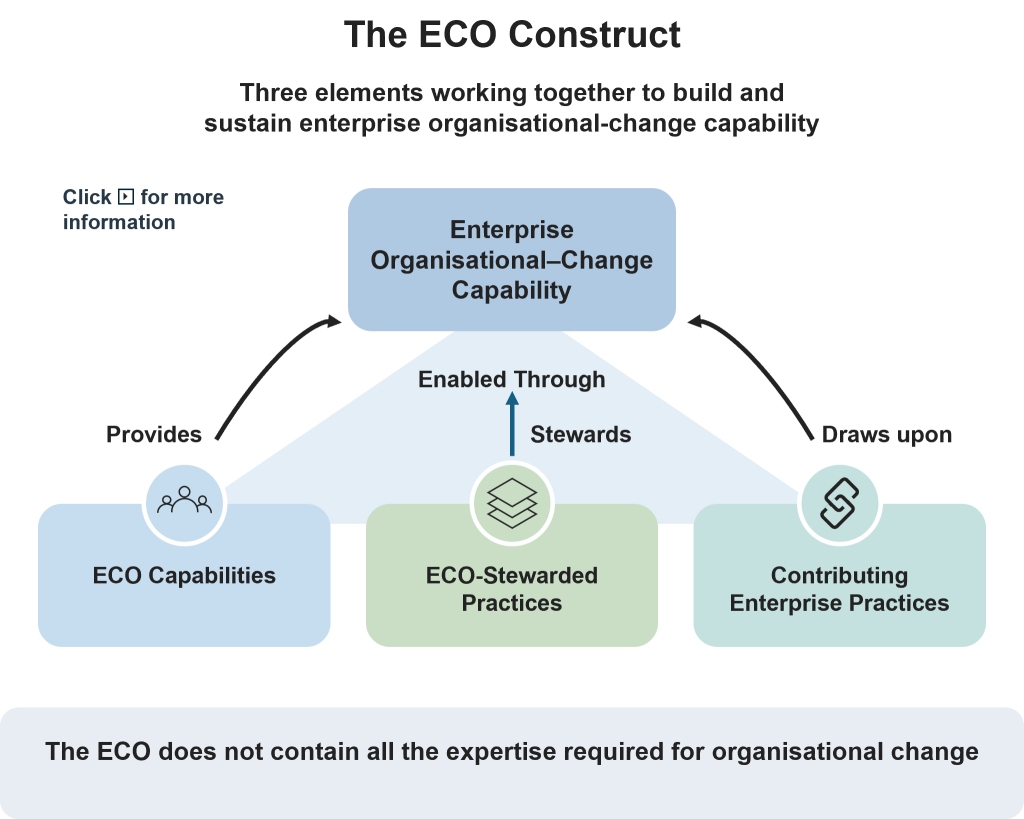
Figure 1 illustrates the ECO construct developed on this website. It focuses on the enterprise’s capability for organisational change, not on managing individual Change Initiatives. It distinguishes between the enterprise-level capabilities the ECO develops, the organisational-change practices it stewards, and the broader enterprise practices that support effective change.
A more change-capable enterprise that can adapt its Enterprise System and, where necessary, its Governing Logic, to realise its strategy and objectives.
1 of 5What the ECO itself provides at enterprise level.
2 of 5Change-specific bodies of practice whose development and stewardship sit with the ECO.
3 of 5Specialist expertise from elsewhere in the enterprise, depending on the nature of the organisational change.
4 of 5The ECO stewards change-specific practices, provides enterprise change capabilities, and enables relevant Contributing Enterprise Practices to be brought together according to the change being undertaken.
5 of 5Figure best viewed on tablet or above

Figure 1: The Enterprise Change Office Construct
The construct also identifies key roles in organisational change, including Sponsors, Initiative Managers, Change Architects, Change Engagement practitioners, Benefits practitioners, and Business Change Managers.
ECO Capabilities
The ECO construct defines four interdependent capabilities for developing and sustaining enterprise organisational-change capability: Enterprise Change Intelligence, Governance & Decision Support, Practice Development & Knowledge Stewardship, and Leadership & Capability Development.
Together, these capabilities enable understanding, governance, support, and continuous improvement of organisational change. They deliver activities such as initiative mobilisation, assurance, portfolio analysis, and enterprise benefits oversight as integrated functions.
The ECO Capabilities
Explore the four ECO Capabilities, including their purpose, principal activities, contributions to enterprise organisational-change capability, and the boundaries of ECO responsibilities.
ECO-Stewarded Practices
The ECO construct identifies four practices for which the ECO provides enterprise-wide stewardship: Initiative Management, Change Architecture, Change Engagement, and Benefits Management. These practices focus on organisational change, are distinct and repeatable, benefit from enterprise-wide development and learning, and have no more suitable organisational home.
Stewardship involves developing and maintaining principles, methods, role expectations, guidance, practitioner capability, and organisational learning. The ECO does not perform all activities related to these practices; practitioners primarily apply them within Change Initiatives and other organisational-change activities.
The ECO-Stewarded Practices
Explore the four ECO-Stewarded Practices, including their purpose, principal activities, practitioner responsibilities, and the boundaries of ECO stewardship.
Contributing Enterprise Practices
The ECO construct distinguishes ECO-Stewarded Practices from Contributing Enterprise Practices. The ECO does not include all specialist expertise required for organisational change. Change Initiatives and Enterprise Probes draw on established enterprise practices such as Finance, Human Resources, Technology and Data, Risk, Legal and Commercial, depending on the change requirements.
Contributing Enterprise Practices
Explore how Contributing Enterprise Practices support organisational change, how their expertise is integrated and the boundaries of ECO responsibilities.
Supporting Two Orders of Organisational Change
The ECO construct recognises two orders of organisational change. First-Order System Change adapts the Enterprise System within the organisation’s existing Governing Logic. It is carried out through authorised Change Initiatives, supported by established lifecycle governance, delivery practices and arrangements for adoption and benefits realisation.
Second-Order Transformational Change occurs when the organisation’s Governing Logic is uncertain or needs reconsideration. It involves questioning assumptions, exploring alternative ways of operating and testing hypotheses through Enterprise Probes. These activities require governance suited to uncertainty and learning, rather than the conventional governance used for authorised Change Initiatives.
A Strategy Office supports strategic sense-making, develops and evaluates hypotheses, and scopes, authorises and reviews Enterprise Probes. The ECO contributes organisational-change expertise to their design, coordination and evaluation, drawing on ECO-Stewarded and Contributing Enterprise Practices as needed. Executive leadership retains decisions about the organisation’s Governing Logic.
What The Enterprise Change Office Does - And Does Not Do
The ECO develops and sustains the enterprise’s capability for organisational change. Its responsibilities are distinct from those of governance bodies, initiative teams, a Strategy Office and Operations. Figure 2 clarifies its scope and boundaries.
| The ECO Develops And Maintains | The ECO Does Not |
|---|---|
| Develops and sustains enterprise organisational-change capability, including common practices, methods, guidance and practitioner development. | Assumes responsibility for managing individual Change Initiatives or replaces their Sponsors, Initiative Managers and teams. |
| Maintains governance processes, provides decision support, assurance and enterprise change intelligence. | Exercises the investment, authorisation or continuation decisions reserved for delegated governance bodies. |
| Stewards Initiative Management, Change Architecture, Change Engagement and Benefits Management as enterprise practices. | Undertakes all activities associated with these practices or assume the responsibilities of appointed practitioners. |
| Facilitates access to relevant specialist expertise and supports its effective contribution to organisational change. | Replaces established enterprise disciplines or directly manages their contributions within individual initiatives. |
| Maintains enterprise-wide visibility of change, dependencies, capacity, expected benefits and learning. | Assumes operational accountability for adoption, sustained use of new capabilities or benefits realisation. |
Figure best viewed on tablet or above
Figure 2: Understanding The Enterprise Change Office’s Boundaries
The Enterprise Change Office Within The Organisation
The ECO operates within a broader set of organisational relationships that connect strategy, organisational change, and Operational Continuity. The Strategy Office supports strategic direction and assesses whether the organisation’s Enterprise System and Governing Logic remain fit for purpose. Governance bodies exercise delegated decision-making authority, while the ECO provides the capability, intelligence and support required for effective organisational change.
Sponsors and Initiative Managers lead Change Initiatives, drawing on specialist expertise and affected operational areas. Operations maintain ongoing performance, adopt new capabilities and sustain their use to realise benefits. The ECO connects and supports these activities through its capabilities and stewarded practices, without assuming the responsibilities of the Strategy Office, governance bodies, initiative teams or Operations.
Establishing a Minimum Viable Enterprise Change Office
Establishing an ECO does not require creating a large new function. Most organisations already have elements of organisational-change capability distributed across existing functions, teams and individuals. The starting point is to assess the adequacy of those capabilities, identify material gaps and determine how existing resources and expertise can be brought together more effectively.
A Minimum Viable ECO can be established with a limited set of responsibilities, resources and capabilities appropriate to the organisation’s change requirements. Its scope and maturity can then develop incrementally, informed by experience, evidence of effectiveness and evolving change portfolio demands.